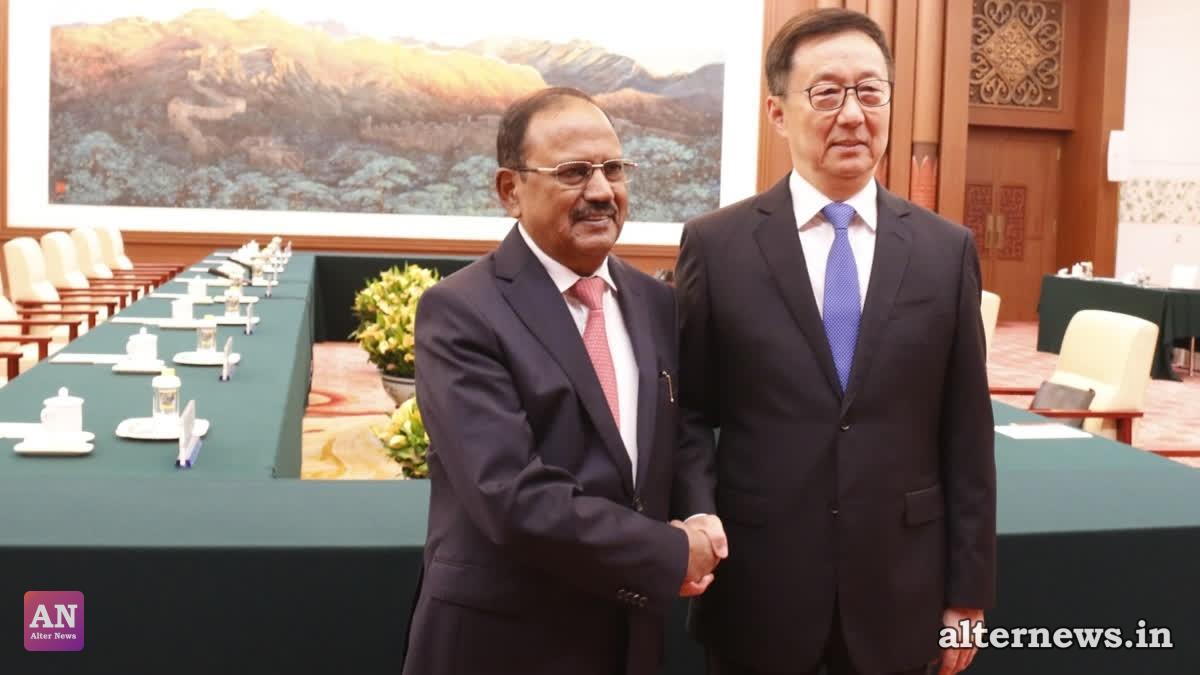
BEIJING — Ahead of high-stakes boundary negotiations, India's National Security Advisor (NSA) Ajit Doval met with Chinese Vice President Han Zheng in Beijing on Tuesday. The dialogue focused on ensuring peace and tranquility along the border areas while charting a roadmap to stabilize broader diplomatic and economic engagement.
Doval, acting as India's Special Representative (SR) on the boundary question, arrived in the Chinese capital on Monday for a two-day official visit. His trip centers on leading the 25th round of SR-level talks with his counterpart, Chinese Foreign Minister Wang Yi.
According to a statement released by the Embassy of India in Beijing, the meeting between Doval and Vice President Han centered on sustaining peace along the Line of Actual Control (LAC) and restoring stability across economic, political, and multilateral channels. Both sides emphasized the importance of aligning bilateral progress with the strategic consensus previously established by top leadership in New Delhi and Beijing.
The timing of the visit carries significant diplomatic weight. The boundary dialogue serves as a crucial foundation ahead of Chinese President Xi Jinping's upcoming visit to New Delhi to attend the BRICS Summit scheduled for September 12–13, where a potential bilateral side meeting with Prime Minister Narendra Modi is anticipated.
Tensions between the two Asian neighbors intensified sharply following the 2020 military standoff in eastern Ladakh and the fatal Galwan Valley clash. While subsequent military and diplomatic negotiations have yielded steady disengagement along several friction points, unresolved issues regarding boundary definitions—particularly around Arunachal Pradesh and eastern Ladakh—continue to test the relationship.
The Special Representative mechanism was established in 2003 to comprehensively address the boundary dispute across the 3,488-kilometer Line of Actual Control. Although a full boundary resolution remains elusive, both nations view the framework as a crucial channel for managing tactical friction, preserving communication, and preventing operational misunderstandings on the ground.