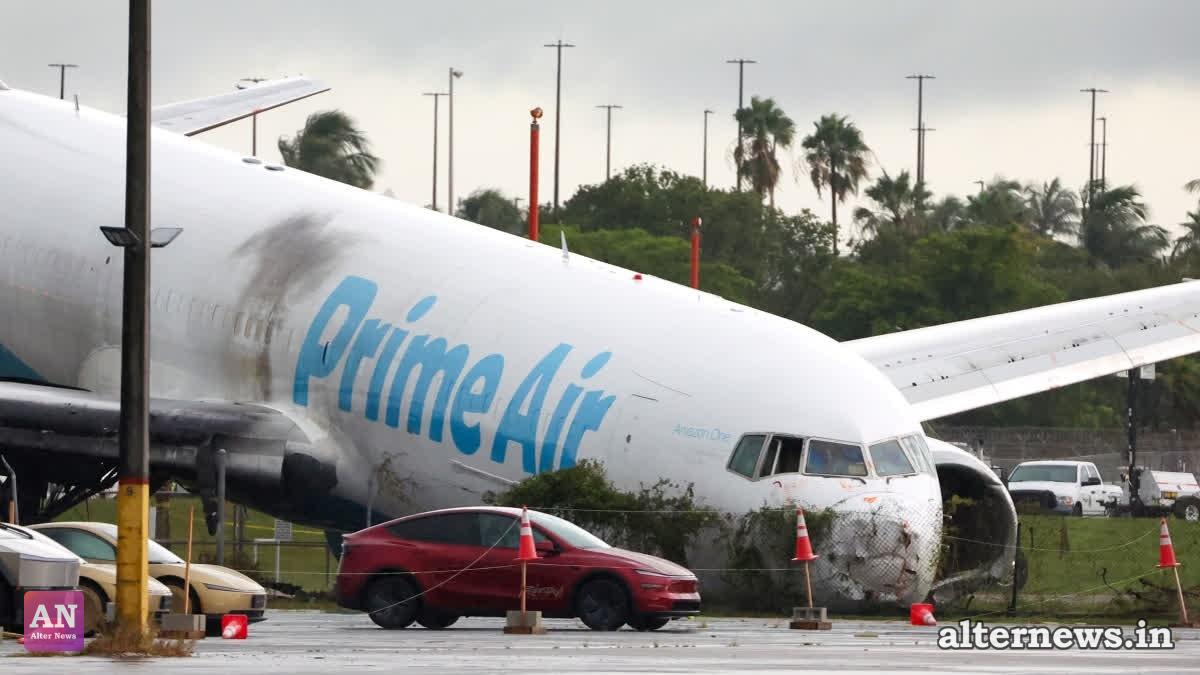
MIAMI — A routine cargo flight turned into a tragedy on Sunday afternoon when an Amazon Prime Air Boeing 767-300 freighter barreled past the end of a runway at Miami International Airport during stormy weather.
The aircraft, operated by North Carolina-based 21 Air as Flight 7598, was completing a two-hour flight from San Juan, Puerto Rico.
Flight data reveals the 32-year-old aircraft was still moving at approximately 112 knots (nearly 130 mph) when it ran out of usable runway.
Devastating Ground Impact
The jet barreled roughly 1,300 feet past the end of the runway, tearing through airfield navigation equipment and smashing through the perimeter fence.
All five people killed in the disaster were occupants of the cleaning service van.
After crushing the van, the plane continued across a public roadway used by warehouse workers, striking an SUV before coming to rest on its belly in a grassy perimeter area with heavy engine fires.
Both the pilot and co-pilot were trapped in the cockpit initially but were safely extricated and later released from the hospital.
Questions Center on Unstable Landing and Wind Conditions
Aviation experts and federal investigators are focusing closely on why the flight crew did not execute a go-around—aborting the unstable landing attempt to fly around for another approach.
"It didn't touch down right away, and so it lost a lot of critical real estate by just continuing to float over the runway. It was literally still flying," noted Mary Schiavo, a pilot and former Transportation Department inspector general, after reviewing landing video.
The National Transportation Safety Board (NTSB) has dispatched a dedicated investigation team led by Chairwoman Jennifer Homendy.
Tailwind & Weather: Strong wind gusts exceeding 25–30 mph were recorded at the airport during landing.
Investigators are looking into air traffic control runway direction assignments relative to prevailing winds. Runway Arrestor Technology: Unlike over 120 U.S. airports equipped with Engineered Materials Arresting Systems (EMAS)—crushable concrete beds designed to quickly stop overrunning planes—Miami International Airport relies on a standard 1,000-foot safety buffer zone.
Flight Recorders: NTSB investigators have recovered both the cockpit voice recorder and flight data recorder to determine crew communications and braking behavior.
In an official statement, Amazon expressed heartbreak over the accident, stating, "Our deepest sympathies go out to the families, loved ones, and all those affected by this devastating loss. We are working closely with local authorities and safety officials to assist the investigation in every way possible."
Flight operations across Miami International Airport experienced severe cancellations and diversions through early week as the NTSB continues its scene documentation.