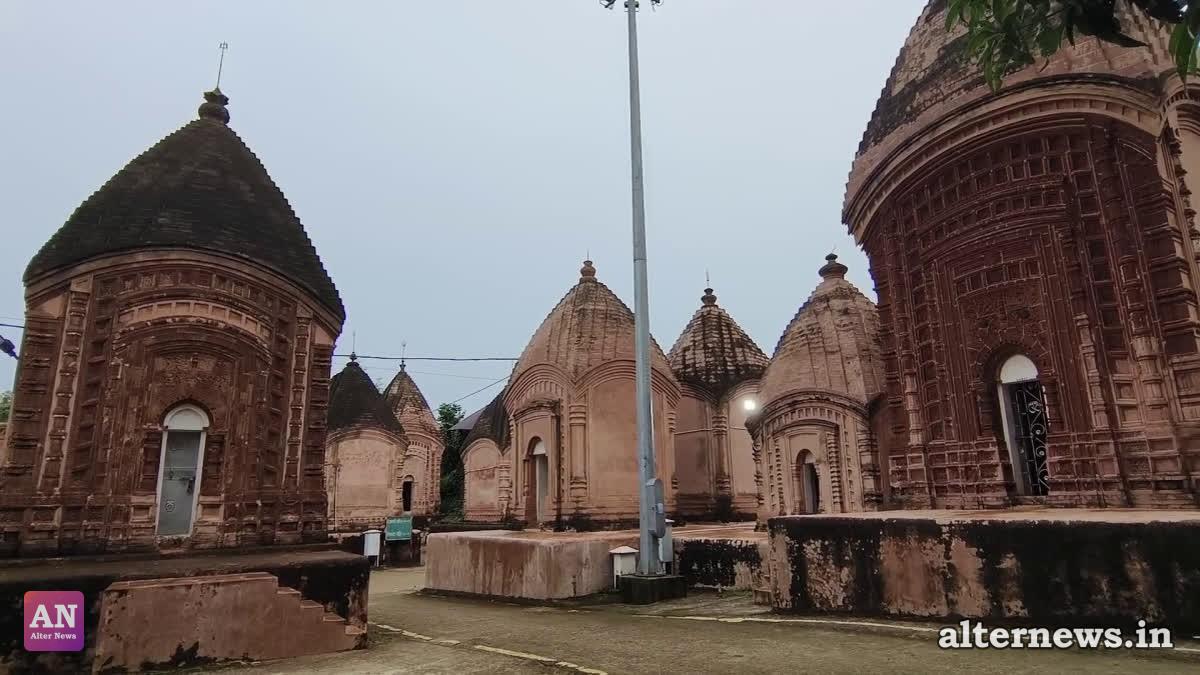
DUMKA: Beauty may lie in the eyes of the beholder, but in Maluti—a quiet border village tucked away in Jharkhand’s Dumka district—it is etched directly into the bricks. Here, clusters of small brick temples stand beside narrow village lanes, peer out from behind residential houses, and dot rural courtyards. While none of these structures overwhelm visitors with massive scale, every inch of their walls draws the eye with intricate artistry.
Crafted from thin bricks, locally sourced soft stone (Phul Pathar), and baked terracotta panels, these shrines recount timeless episodes from the Ramayana, the Mahabharata, and the life of Lord Krishna. Scenes depicting the epic battle between Rama and Ravana, the daring exploits of Hanuman, and an array of gods, warriors, and everyday rural life spring to life across the temple exteriors.
Though time has taken its toll—leaving some structures leaning precariously, others stripped of ornamentation, and dozens lost entirely—what remains transforms this remote corner of Jharkhand into an extraordinary open-air record of religion, royalty, and rural heritage.
A Legacy of Rivalry and Devotion
Once believed to boast 108 distinct Shiva shrines, Maluti preserves roughly 70 to 72 temples today. This concentration of sacred structures has earned the settlement two revered titles: "Gupta Kashi" (Hidden Kashi) and "Shaivakshetra" (the sacred land of Shiva).
Local folklore traces the origins of Maluti’s royal lineage to a fascinating legend involving a lost hawk, a benevolent Sultan of Gaur, and a shepherd named Basanta Roy. Rewarded with tax-free land, Roy established a zamindari that evolved into the Nankar kingdom.
Centuries later, following a bitter territorial defeat by the ruler of Rajnagar, the royal family fractured into four branches. Rather than constructing a single, unified religious complex, each branch began erecting clusters of temples across their respective neighbourhoods—partly as an intense display of personal devotion, and partly to outdo and assert dominance over rival family factions. This generation-spanning architectural competition ultimately blessed Maluti with its astonishing wealth of shrines.
Artistic Brilliance and Cultural Crosscurrents
Situated right on the border of West Bengal's Birbhum district (only 15–16 km from the famous Tarapith temple), Maluti heavily reflects the rich artistic traditions of Bengal. Artisans utilized Phul Pathar to delicately carve figures, while master craftspeople—believed to have come from Bishnupur—molded intricate terracotta panels.
According to Dr. Srila Basu, an expert on Bengal’s terracotta temples from Visva-Bharati University, the unique concentration of Phul Pathar and terracotta carvings makes Maluti completely one-of-a-kind. "Nowhere else will one find such a concentration of temples decorated with this distinct artistry," she notes, emphasizing how these walls act as historical windows into the social, economic, and cultural dynamics of the 17th to 19th centuries.
A Call for Preservation
Despite its profound historical and architectural significance, decades of neglect, natural erosion, and inadequate maintenance have caused more than 30 original temples to disappear. Experts warn that every damaged wall represents an irreplaceable loss of indigenous history and artistic heritage.
Even so, Maluti remains a living pilgrimage destination. Daily worship continues unabated at the historic Mauliksha temple—dedicated to the royal family’s crimson-hued deity—and across several surviving Shiva shrines.
Easily accessible by road from Dumka town or via West Bengal's Rampurhat Junction, Maluti offers a rare travel experience. Here, history is not locked away behind the sterile glass of a museum; it remains vibrantly alive, written across village paths through weathered brick, soft stone, and timeless terracotta.