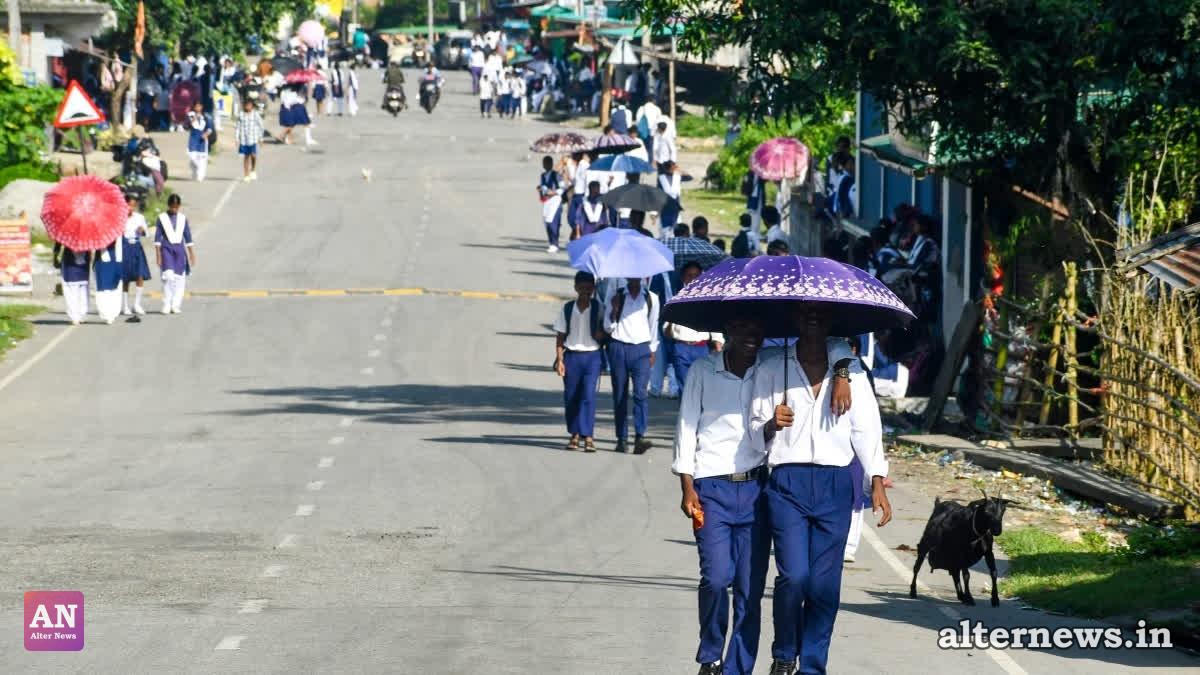
NEW DELHI — For millions across India—from outdoor laborers battling sweltering heat during grueling double shifts to pregnant women in informal settlements struggling through power cuts—extreme heatwaves have long been a devastating seasonal reality. Relief has finally materialized in policy, as the Central Government officially classified heatwaves as a notified natural calamity on August 4.
The landmark policy shift enables state governments to unlock dedicated disaster management funds, establishing legal and financial backbones to deploy targeted mitigation strategies and protect human lives.
Mobilizing Capital for On-the-Ground Action
Speaking on the Centre's directive, Krishna S. Vatsa, Head of Department at the National Disaster Management Authority (NDMA), emphasized that heatwaves are no longer isolated weather anomalies but systemic, long-term environmental hazards.
"Once notified as hazards, states will be able to access the State Disaster Response Fund (SDRF) and State Disaster Mitigation Fund (SDMF) to respond to and mitigate both lightning and heatwaves," Vatsa stated. He noted that while previous responses remained largely confined to policy frameworks and public awareness campaigns, the new disaster status provides concrete capital to execute physical measures.
Vatsa highlighted that state allocations can function as seed assistance to leverage municipal funds, corporate social responsibility (CSR) initiatives, and civic partnerships. Municipal corporations and district administrations can now draw on these funds to build public cooling shelters, install clean drinking water kiosks, and incorporate thermal comfort designs into urban architecture.
Tackling the Economic and Labor Impact
Beyond immediate public health risks, climate experts stress the immense economic toll extreme heat inflicts on India’s workforce.
Dr. Arunabha Ghosh, Founder and CEO of the Council on Energy, Environment and Water (CEEW), pointed out that earlier regulations constrained states, limiting them to tapping roughly 10% of their SDRF and 20% of SDMF reserves for non-notified disasters—a restrictive threshold now eliminated.
"India is a growing economy that will continue to expand for decades, meaning more infrastructure will keep getting built, and much of the workforce will continue working outdoors," Dr. Ghosh noted. "Heat stress, therefore, isn't just a climatic event; it's an economic calamity, impacting workforce productivity."
Ghosh urged policymakers to integrate proactive mitigation into labor regulations. This includes updating labor laws to enforce adequate ventilation for both outdoor and indoor work environments and extending structural support to the country's vast informal labor sector.
Health System Readiness and Financial Protection
Healthcare professionals have welcomed the notification, emphasizing that effective execution will dictate its real-world success.
Dr. Harshal Ramesh Salve, a physician at the All India Institute of Medical Sciences (AIIMS), New Delhi, underscored the importance of breaking the cycle between heat-induced illness and economic hardship. Vulnerable communities often incur crippling out-of-pocket medical expenses during extreme weather events.
"Providing financial support or rehabilitation through state-sponsored schemes can improve the economic status of affected individuals while preventing financial hardship caused by illness," Dr. Salve explained, adding that treating and preventing heat casualties requires systemic prioritization and early identification of high-risk groups.
Bridging Policy and Local Execution
Expert analysis indicates that national recognition solves a long-standing structural disconnect. Abhiyant Tiwari, lead for Health and Climate Resilience at the Natural Resources Defense Council (NRDC) India, compared the decision to the unified national response triggered during the COVID-19 pandemic.
While nearly a dozen individual states had previously declared heatwaves as local disasters, national notification provides crucial policy coherence across national, state, and district disaster management funds (NDRF, SDRF, NDMF, and SDMF).
"India's heat action plan framework was already in place nationwide before the notification," Tiwari said. "We prepared in advance, and now have the legal and financial backing to turn plans into action on the ground."
With the regulatory framework established, experts agree that the priority must shift from drafting more Heat Action Plans (HAPs) to funding, scaling, and embedding them into robust early-warning systems and long-term urban design.