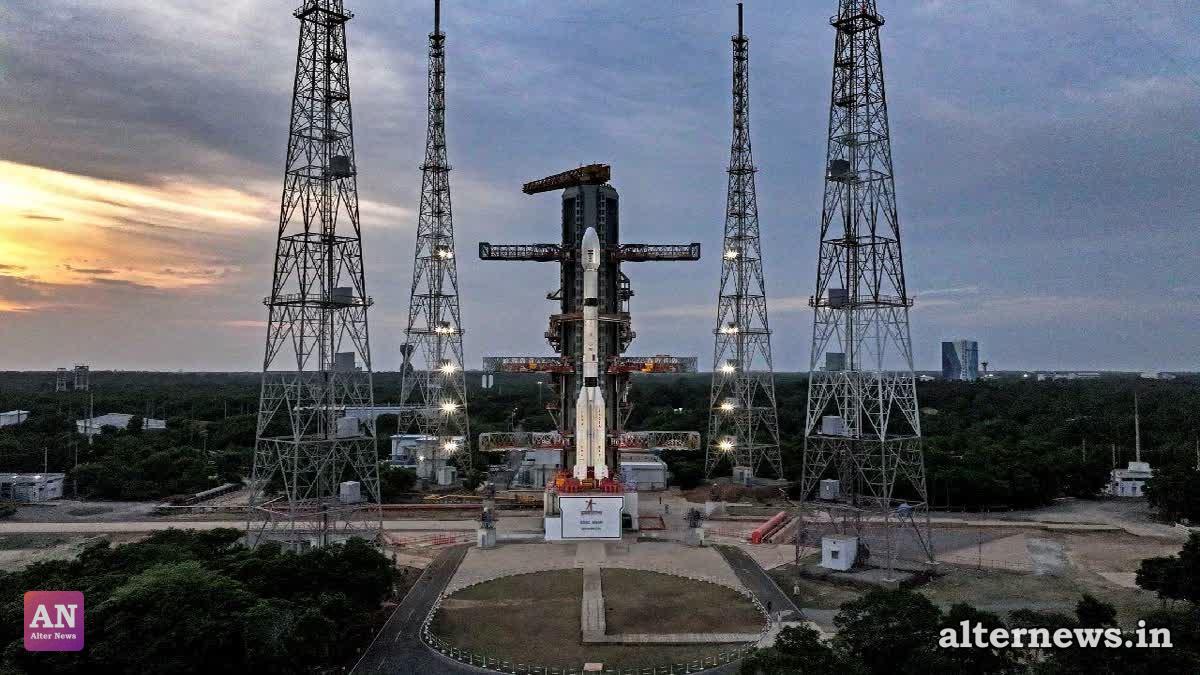
SRIHARIKOTA — In a major breakthrough for India’s space capabilities, the Indian Space Research Organisation (ISRO) successfully launched EOS-05—the country’s first geo-imaging satellite—into a Sub-Geosynchronous Transfer Orbit in a pre-dawn mission on Friday.
The 51.7-meter-tall Geosynchronous Satellite Launch Vehicle (GSLV-F17) roared into the night sky at precisely 2:55 AM IST from the Second Launch Pad at the Satish Dhawan Space Centre (SDSC-SHAR). The success marks a crucial triumph for ISRO, ending an eight-month launch lull and replacing the failed GSLV-F10 mission from 2021.
Despite light rainfall and the early morning hour, crowds of spectators gathered at Sriharikota to watch the 420.5-tonne, three-stage rocket—equipped with an indigenous Cryogenic Upper Stage—carry its 2,367 kg payload into the atmosphere.
Confirming the mission's precision, ISRO Chairman Dr. V. Narayanan stated, "I am very happy to announce that the GSLV-F17 vehicle has successfully and precisely injected the advanced Earth observation satellite EOS-05, the Geo-Imaging Satellite, into the intended and required orbit."
Prime Minister Narendra Modi lauded the mission on social media platform X, describing the launch as a proud moment for the nation.
"Yet another outstanding achievement by ISRO and a proud moment for our nation. The successful launch of GSLV-F17 carrying EOS-05, India's first-ever imaging satellite from Geosynchronous orbit is a reflection of the excellence, innovation and growing capabilities that define India's space sector," the Prime Minister wrote, highlighting the expanding synergy between ISRO and India's growing private space industry.
Unlike conventional Earth observation satellites operating from Low Earth Orbit (LEO) at lower altitudes, EOS-05 will hover in geosynchronous orbit roughly 36,000 kilometers above the Earth. At this altitude, the satellite matches the Earth’s rotational speed, allowing it to maintain a continuous, fixed watch over the Indian subcontinent.
This geostationary vantage point will yield continuous, real-time imaging vital for disaster management, agricultural monitoring, weather tracking, and national security surveillance.
The successful GSLV-F17 flight marks the 19th launch for India's GSLV rocket program and brings crucial momentum back to ISRO after technical issues hindered previous launch attempts over the past year. With EOS-05 now safely in orbit, ground controllers will begin deploying its operational systems to bring India’s eye-in-the-sky online.