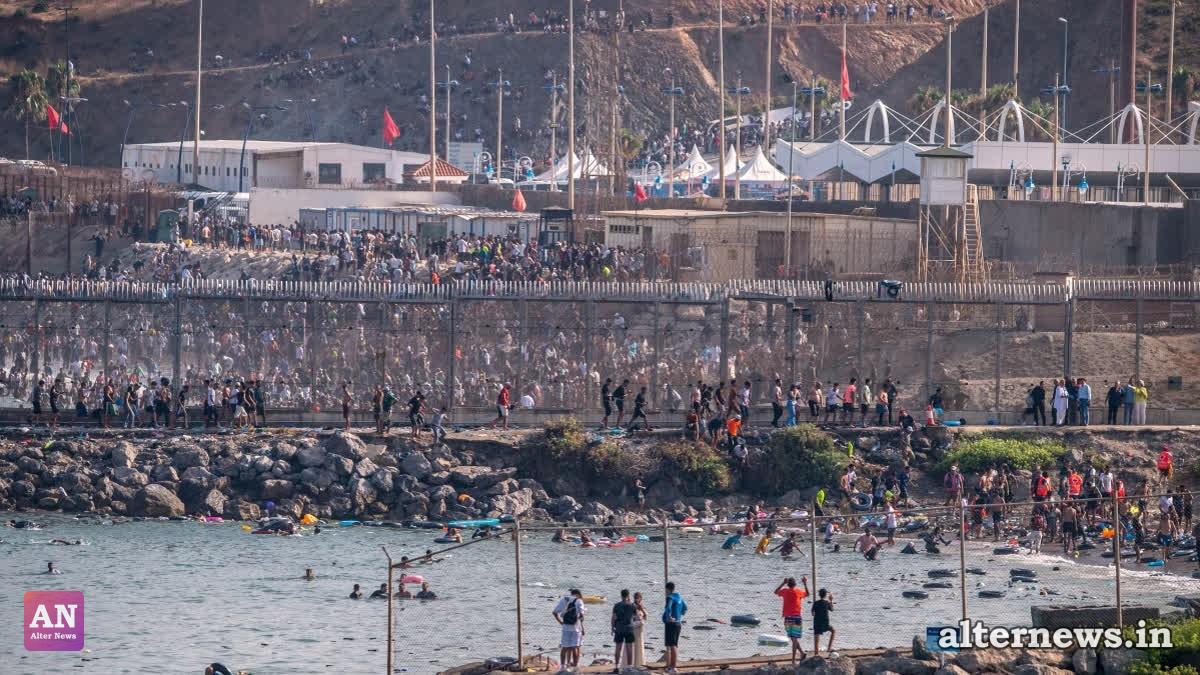
CEUTA — When news spread across northern Morocco that the border security forces had been overwhelmed, 21-year-old student Abdulah Buji did not hesitate. He jumped on his motorcycle, sped toward the border, and plunged into the Mediterranean Sea alongside tens of thousands of his countrymen, all attempting to swim into the tiny Spanish enclave of Ceuta.
For Buji, studying to become a teacher back home offered little hope against Morocco’s bleak economic horizon. “Spain gives you the chance to make your future, not like Morocco,” Buji said after reaching Spanish soil. “I am a talented boy. I just want a chance.”
His story reflects the overwhelming sense of despair driving an unprecedented migration wave. Between Thursday and Friday, an estimated 60,000 people attempted the perilous journey—a figure equivalent to nearly 70% of Ceuta’s entire resident population.
A Harsh Reality on European Soil
For Buji and tens of thousands of others, the exhilaration of stepping onto European territory was short-lived. Mainland Europe remained miles away across the Mediterranean, separated by strict maritime patrols and immediate deportation directives.
Lacking money and basic supplies after losing his belongings in the dangerous sea crossing, Buji soon realized the bitter truth: Spanish military forces and riot police were enforcing strict border controls, ordering new arrivals to return immediately or face detention.
“I’ve spent perhaps 14 years studying, but there’s nothing at home, and I’d have to work 12-hour shifts for a meagre wage,” Buji recounted. “That’s why I came here, but I haven’t found any opportunities here either, so I have to go back.” Facing legal limbo, he ultimately turned back toward Morocco, among the more than 50 people who tragically lost their lives during the swimming attempt around the coastal border fence.
Humanitarian Crisis and Local Panic
By Friday afternoon, an estimated 45,000 of the 60,000 migrants had returned or been pushed back into Moroccan territory. However, thousands remained stranded in the streets of Ceuta overnight, leaving local residents startled and prompt Spanish municipal authorities to call in military reinforcements to restore order.
Local authorities described the scene as the largest logistical and security challenge the enclave had faced in years, surpassing a similar breach in 2021 when border restrictions briefly collapsed.
The movement was exacerbated by social media campaigns that viralized days before the surge, offering detailed guides on crossing routes, timing, and advice on how to handle interactions with European border agents. The digital calls to action led to crowded train and bus stations across major Moroccan hubs, including Rabat and Casablanca, where security forces scrambled to block young people from traveling north.
Driven by Despair and Obligation
Migration experts emphasize that the mass movement is rooted in deep structural economic problems in North Africa.
“They’re doing it out of despair, because they’ve tried other ways to build a life and failed,” explained Myriam Cherti, a senior researcher at Oxford University’s Centre on Migration, Policy and Society. “They feel the obligation that they want to help their families and support them. That’s possible if they make it to Spain, but not necessarily possible if they stay.”
For 33-year-old Ahmed Karim, who has been unemployed for months, the border represents a gateway that remains systematically closed to ordinary citizens. "Many Moroccans want to go to Europe or America, but they simply don’t have the opportunity through official channels," Karim said.
Desperate Searches Amid the Chaos
Not everyone who crossed was seeking asylum or employment in Europe; some entered the chaotic border zone purely to locate missing family members.
Ikrra Khai, a 33-year-old agricultural worker who holds a valid seasonal permit to work in Spain, spent Friday wandering Ceuta's streets holding her friend's brother's residency card.
“I don’t know if he is dead or alive,” Khai said, scanning the crowds of young men. “I have his residency card, but I don’t know where he is. I’m searching.”
As Spanish forces gradually stabilize the border and Moroccan authorities re-establish checkpoints, the underlying driver of the crisis—a generation of young North Africans seeing no viable economic path at home—remains completely unaddressed.