KATHMANDU: In the aftermath of the catastrophic August 26 Bhotekoshi flash floods, the government of Nepal has estimated that it will require a staggering Rs 723.31 billion (approximately $4.74 billion US dollars) to reconstruct and restore damaged infrastructure, homes, and public utilities across the Himalayan nation.
The preliminary financial estimate is the result of a comprehensive 'Rapid Damage and Needs Assessment' (RDNA) conducted jointly by technical teams from Nepal's National Planning Commission (NPC) and the National Disaster Risk Reduction and Management Authority (NDRRMA). This critical assessment arrives as Nepal's Foreign Minister, Shisir Khanal, actively demands climate compensation from major global polluters, highlighting that Nepal contributes less than 0.1 percent of global greenhouse gas emissions.
According to the RDNA report, infrastructure recovery accounts for a massive 75 percent of the total cost. Roads, hydropower generation plants, and solar power facilities suffered extensive destruction across districts like Rasuwa, Nuwakot, and Dhading. Officials note that restoring this critical infrastructure alone will require an estimated Rs 474 billion.
Detailing the data collection process, NDRRMA Chief Executive Dharam Raj Uprety explained that the figures were compiled using real-time information from multiple government ministries, departments, and local bodies. "This is just a preliminary estimate compiled by using data from the department of roads, and various ministries including energy, agriculture, ministry of education and sports. We compared post-flood statistics with the data previous to it, and also used drones to survey the extent of loss," Uprety stated.
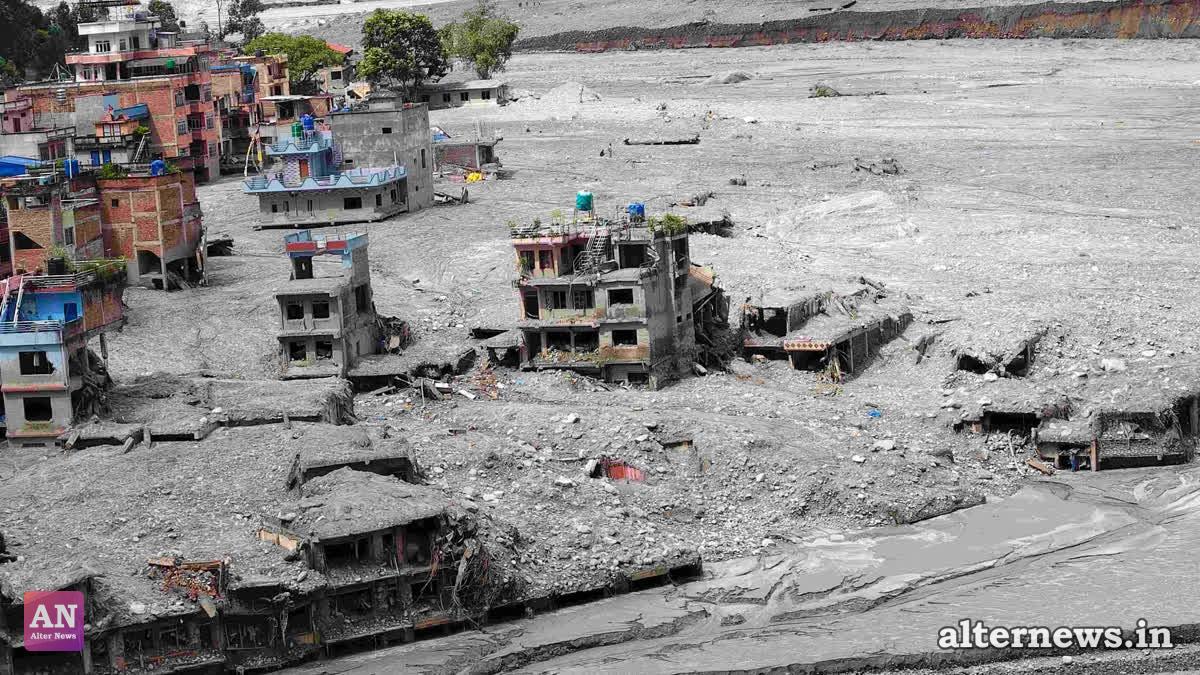
Data from the Prime Minister’s Office (PMO) highlights the sheer scale of the physical devastation: roughly 69 kilometers of roads were severely damaged, 33 motorable bridges were washed away, and 53 out of 64 suspension bridges in the affected zones suffered major damage. In the energy sector, 13 hydropower projects with a collective generating capacity of 759 megawatts, alongside 5 solar power plants, were heavily disrupted.
Residential areas, schools, government buildings, and cultural heritage sites also bore the brunt of the disaster. NDRRMA records indicate that 7,570 private homes were damaged across five districts—with Bidur municipality in Nuwakot being the hardest hit, accounting for around 3,026 damaged houses. Additionally, the floods wiped out roughly 1,806 hectares of crops, destroyed 4,800 commercial establishments, and left massive deposits of sludge, silt, and debris that require costly clearance operations.
The unprecedented disaster was triggered on August 26 by a suspected glacial avalanche or glacial lake outburst in Tibet, which sent a violent wall of water and debris cascading down the Bhotekoshi river and into the Trishuli river channel.
As rescue and relief efforts spearheaded by the Nepali Army, police, and paramilitary units continue, authorities confirm that around 1,377 bodies have been recovered, while over 5,130 individuals remain missing. More than 13,673 people have been safely evacuated, with thousands currently sheltered in designated relief camps.