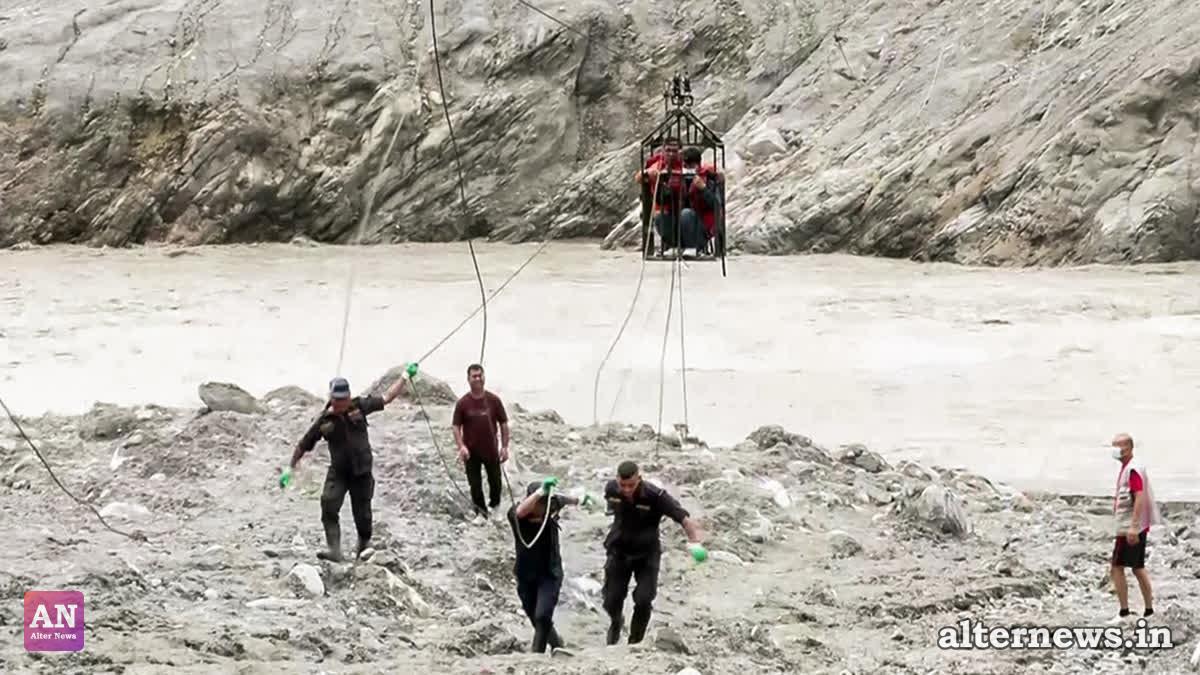
KATHMANDU / NEW DELHI — The death toll from the catastrophic Himalayan glacial floods in Nepal has climbed to 1,290, with official casualty counts continuing to rise for a ninth consecutive day. More than 4,000 people remain missing or uncontactable across the disaster zone, as emergency personnel work against time and harsh terrain to search for survivors.
The disaster unfolded when an ice-rock avalanche triggered a massive glacial collapse near the Nepal-Tibet border, sending a torrent of water, thick mud, and heavy debris roaring through central Nepal’s river valleys. The surge obliterated entire villages, severed major highway connections, destroyed critical infrastructure, and swept away multiple hydroelectric power projects. The disaster also struck northern neighboring territories, claiming at least 21 lives on the Chinese side of the border, where nearly 540 people are currently listed as missing in Tibet.
Rescue operations remain on a war footing across central Nepal, particularly around submerged industrial sites. Emergency teams are working frantically to reach approximately 100 hydropower workers who are believed to be trapped inside underground tunnels buried deep under mud and structural debris. Excavation efforts at these rescue shafts face continuous setbacks due to persistent groundwater seepage and unstable soil conditions.
In response to the expanding humanitarian crisis, India has intensified its emergency relief pipeline. On Thursday evening, the Indian Air Force dispatched two C-130J Super Hercules transport aircraft loaded with 21.5 tonnes of humanitarian aid to Nepal. Ministry of External Affairs (MEA) Spokesperson Randhir Jaiswal confirmed that the fresh airlifts contain essential medical supplies, emergency equipment, and specialized forensic collection kits to reinforce local rescue and relief operations.
Addressing the critical challenge of identifying victims, the Indian Ministry of External Affairs announced on Thursday that central and state-level forensic laboratories will provide DNA profiling services to first-degree biological relatives of missing persons.
Under this initiative, parents, children, and siblings residing in India can submit biological samples at Central Forensic Science Laboratories (CFSLs), State Forensic Science Laboratories (SFSLs), National Forensic Sciences University (NFSU) facilities, and NABL-accredited diagnostic labs. The resulting DNA profiles will be cross-matched with forensic data collected from unidentified mortal remains in Nepal to assist grieving families in obtaining closure.
The scale of the devastation has sent shockwaves through the region, putting Himalayan vulnerability under intense global scrutiny. In New Delhi, Union Home Secretary Govind Mohan convened a high-level meeting on Thursday to evaluate India's own risk profile regarding Glacial Lake Outburst Floods (GLOFs) and avalanche hazards across Himalayan states and Jammu & Kashmir. Officials emphasized the need for real-time monitoring and reinforced early-warning infrastructure to prepare for potential hazards caused by rapid snowmelt, unstable glaciers, and unpredictable weather patterns.