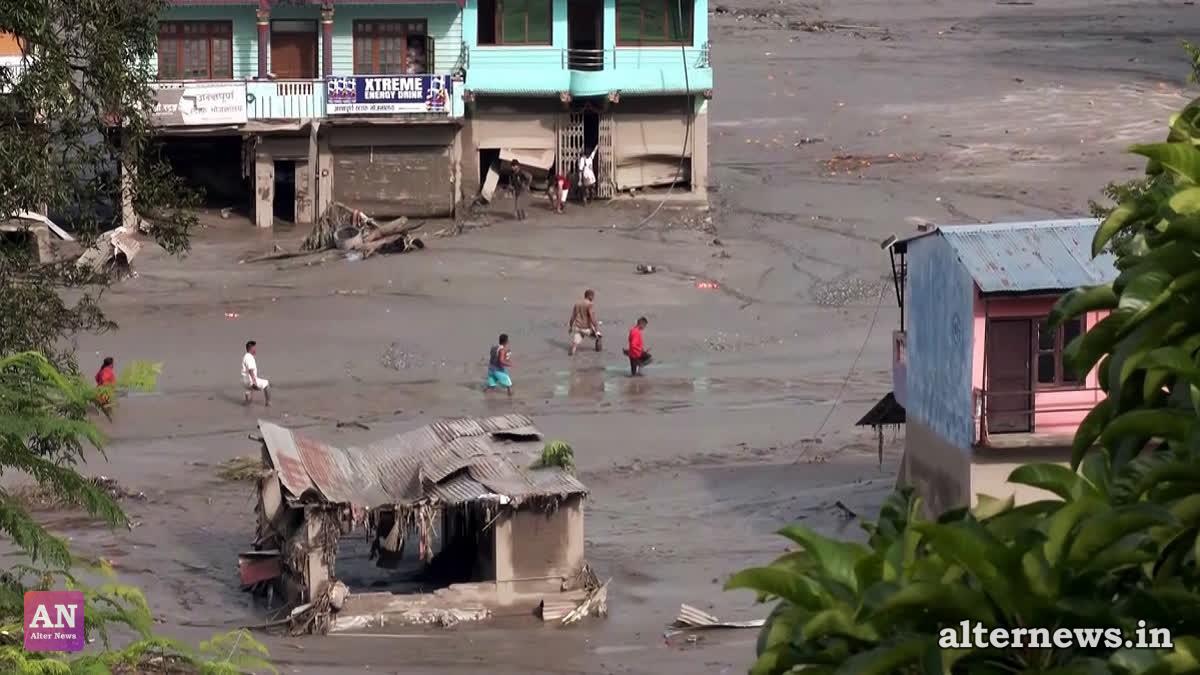
KATHMANDU / NEW DELHI — The death toll from catastrophic flash floods along the Nepal-Tibet border has jumped to 469, Nepalese authorities confirmed on Friday, as emergency teams race against time and secondary disaster warnings to locate hundreds of missing persons, including nearly 290 Indian nationals.
Rescue operations entered their third straight day across eight devastated districts in central and northern Nepal. Over 7,400 security personnel—including 2,391 soldiers from the Nepalese Army—have been deployed alongside heavy machinery, search dogs, drones, and fleet helicopters to cut through thick layers of mud, rock, and wreckage left downstream.
Glacial Collapse Sparks Downstream Havoc
The disaster unfolded on Wednesday after a massive ice-rock avalanche, triggered by a glacial collapse in the high Himalayas, crashed into the Lhende River about 20 kilometers northeast of the Rasuwagadhi border crossing. Seismic analysis initially misinterpreted the shockwave as a magnitude 4.4 earthquake before the U.S. Geological Survey (USGS) confirmed the event was generated by a high-altitude collapse.
The surge breached temporary natural dams and funneled millions of tons of mud and water into the Bhote Koshi and Trishuli river systems. Entire settlements, key highway links, hydro-infrastructure, and bridges were swept away in minutes.
According to Nepal Police, recovery operations have yielded fatalities across eight key districts:
Chitwan: 178 bodies recovered
Nawalparasi East: 110 bodies recovered
Gorkha: 44 bodies recovered
Nuwakot: 37 bodies recovered
Dhading: 33 bodies recovered
Tanahu: 28 bodies recovered
Nawalparasi West: 27 bodies recovered
Rasuwa: 12 bodies recovered
More than 1,545 injured or stranded individuals have been rescued so far, with 84 patients receiving specialized emergency treatment in Kathmandu hospitals.
Hundreds of Indians Uncontactable; India Ramps Up Disaster Relief
The Indian Ministry of External Affairs (MEA) confirmed that 290 Indian citizens in the affected areas remain untraceable. Efforts to establish contact are complicated by severe network outages and physical blockades along border highways.
External Affairs Minister S. Jaishankar stated that New Delhi is coordinating closely with officials in Kathmandu, regional tour operators, and state authorities to locate missing citizens. Most affected Indian travelers were en route to Gosainkunda in Bagmati Province or on pilgrimage to Mount Kailash in Tibet.
India has dispatched 47.5 tonnes of Humanitarian Assistance and Disaster Relief (HADR) supplies via Indian Air Force transport planes, delivering medical equipment, shelter kits, and essential food rations directly to Nepal. Meanwhile, around 84 Indians have already been safely evacuated, including 63 workers from the Trishuli-I hydroelectric project and 21 pilgrims hailing from Tamil Nadu.
Threat of Secondary Outbursts
Operational challenges have intensified following warnings from Chinese hydrological monitors that a new barrier lake has formed upstream near the Chhochen Khola and Purepu Tsangpo confluence in Tibet.
An estimated 2 million cubic meters of water accumulated behind the unstable debris dam within 24 hours, with projections indicating another 3 million cubic meters could collect shortly. Authorities in both nations warned that a sudden breach could send a devastating second wave through the Bhote Koshi and Trishuli corridors. Chinese disaster personnel equipped with advanced satellite and sonar gear have been deployed to Gyirong Township to evaluate emergency drainage options.
Transport Links Severed
Infrastructure damage across northern Nepal remains severe. The Department of Roads reported that the entire 42-kilometer arterial highway between Betrawati and Rasuwagadhi has been destroyed at multiple points. In total, 35 motorable bridges, 45 suspension bridges, and roughly 40 kilometers of paved roads were rendered unusable, cutting off rural populations and slowing heavy rescue machinery.
Nepal Prime Minister Balendra Shah visited damaged zones in Nuwakot to review relief efforts, while Chinese Premier Li Qiang inspected frontline operations in Gyirong Township. Multiple nations, including the U.S. and U.K., have extended offers of technical and logistical assistance as casualty figures continue to rise.