KATHMANDU — The death toll from catastrophic flash floods across Nepal and Tibet has climbed to 1,222, as emergency responders continue to recover bodies from thick mud and debris a week after a glacial collapse unleashed deadly torrents through central Nepal.
According to Nepal’s National Disaster Risk Reduction and Management Authority (NDRRMA), more than 4,000 people—including local residents, security personnel, and foreign tourists—remain missing. On the Chinese side of the border in Tibet, authorities have confirmed 21 deaths, with nearly 540 people still unaccounted for.
Widespread Destruction Across Eight Districts
The catastrophe began when an ice-rock avalanche triggered a massive glacial lake outburst along the Nepal-Tibet border. A wall of water, mud, and boulders roared downstream, obliterating entire settlements, tearing down critical infrastructure, and severely damaging several major hydroelectric power plants.
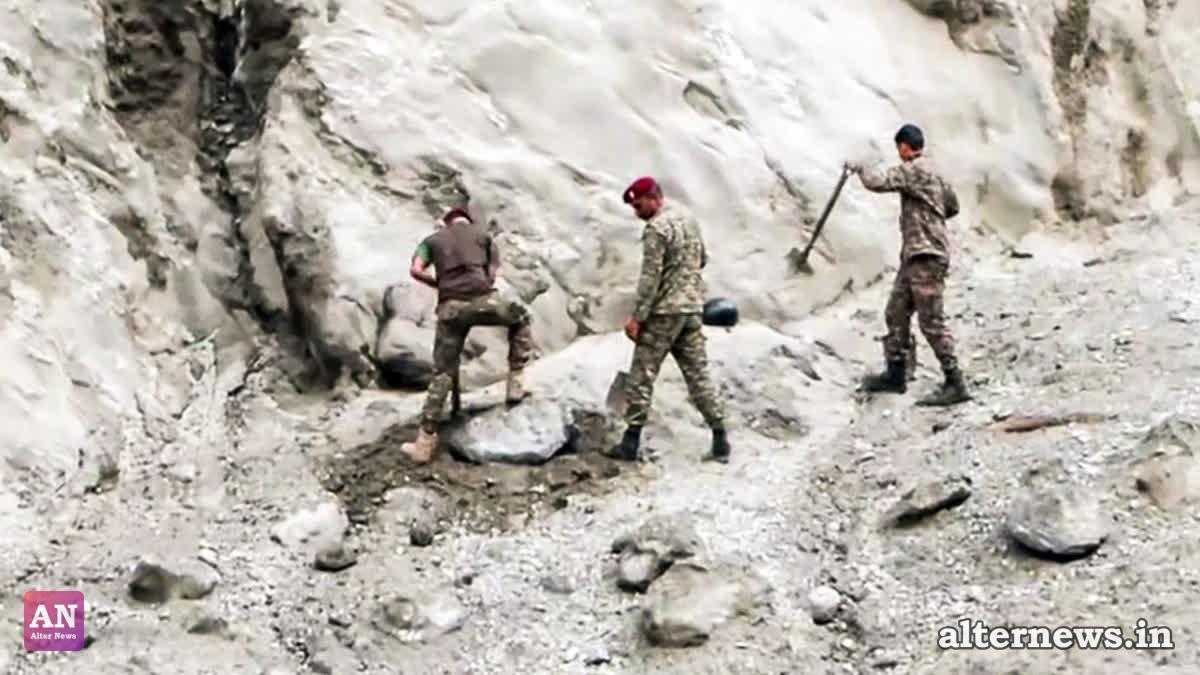
Disaster response teams have been deployed across all eight affected districts. Over 21,000 security personnel are involved in search, rescue, and clearance operations under extreme conditions.
According to the latest NDRRMA figures, Chitwan district has suffered the highest casualties, with 348 bodies recovered so far. Recovery efforts in other hit regions include:
Nawalparasi East: 218 bodies
Nawalparasi West: 208 bodies
Nuwakot: 155 bodies
Rasuwa: 127 bodies
Gorkha: 69 bodies
Dhading: 60 bodies
Tanahu: 38 bodies
India Mobilizes Specialized Rescue Units and Relief
In response to the growing crisis, India has intensified its humanitarian aid and technical support. The Ministry of External Affairs (MEA) confirmed that a fifth Indian military transport aircraft landed in Nepal early Thursday, delivering an 11-member specialized search crew, advanced equipment, and 5.5 tonnes of essential medicines. Indian Ambassador Naveen Srivastava formally handed over the emergency supplies to Nepali officials in Kathmandu.
To assist with difficult subsurface extractions, a specialized 19-member Indian tunnel rescue team has partnered with the Nepali Army to conduct joint search operations at critical underground hydropower infrastructure sites, including the heavily damaged Chilime project.
Additionally, a 19-member Indian forensic science team has set up operations in Kathmandu to help local authorities identify recovered bodies.
Hundreds of Indian Nationals Accounted For, Search Continues
Ministry of External Affairs spokesperson Randhir Jaiswal confirmed that 163 Indian nationals caught in the deluge have been safely rescued and evacuated. However, concerns remain high as more than 275 Indian citizens and 128 Persons of Indian Origin (PIOs) are still reported missing or untraceable across the flood-ravaged terrain.
Rescue operations remain active, but responders face severe challenges due to severed road connections, damaged communication networks, and unstable, mud-soaked ground.