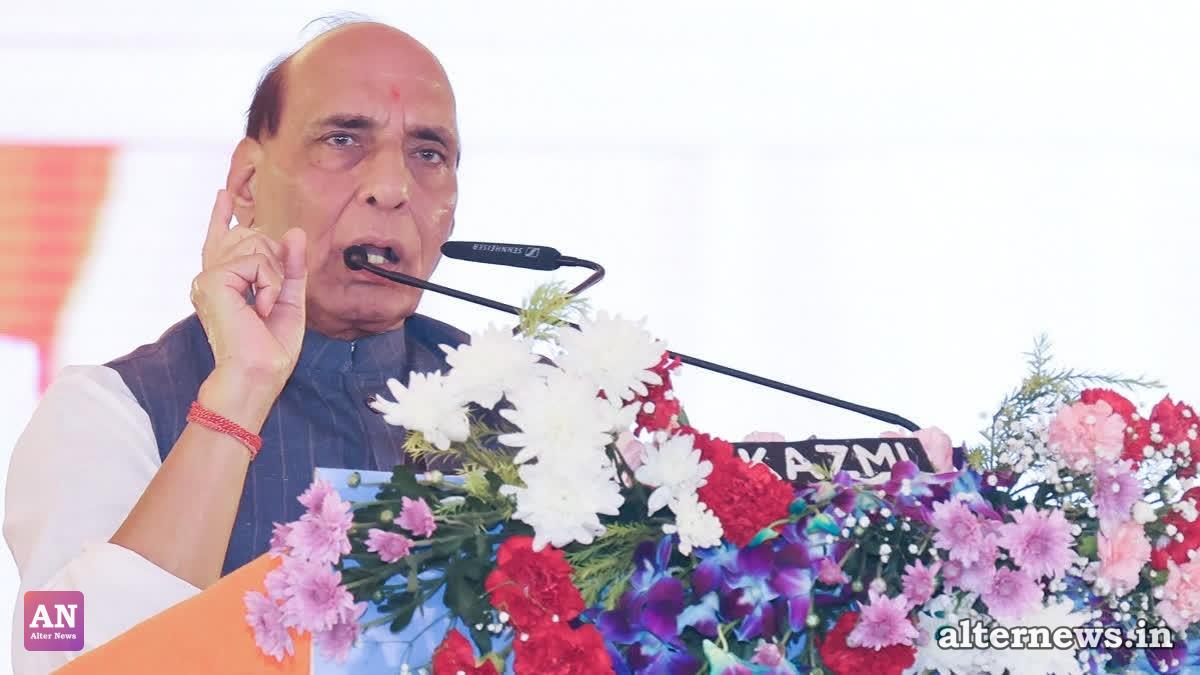
NEW DELHI — In a stern message to adversary nations, Defence Minister Rajnath Singh declared that the Indian armed forces have been granted complete operational freedom and resources to respond decisively to external threats, including executing counter-strikes deep inside enemy territory.
Speaking at a national security event, Singh emphasized that while India remains deeply committed to global peace and holds no territorial ambitions against its neighbors, the nation will not allow peace to be mistaken for vulnerability or weakness.
"Peace born of the fear of war is to be condemned, while war fought for the sake of peace is worthy of reverence," the Defence Minister said, underlining India's firm stance against cross-border state-sponsored terrorism.
Shift to Proactive Strategic Autonomy
Highlighting the evolution of India’s national security doctrine under Prime Minister Narendra Modi's leadership, Singh noted that the country’s defense stance has transitioned from reactive measures to proactive deterrence.
The minister added that amidst shifting geopolitical dynamics, India continues to maintain its strategic autonomy.
Foiling Proxy Warfare and Hybrid Threats
Addressing internal and hybrid security challenges, Singh stated that adversary attempts to destabilize the nation through proxy warfare—specifically in Jammu & Kashmir—have been systematically dismantled.
Singh also noted that modern battlefields now extend well beyond land, sea, and air into space and cyberspace.
Surge in Indigenous Defence Production and Exports
Underlining the success of the 'Aatmanirbharta' (Self-Reliance) vision in defence, the minister shared key economic milestones detailing India's growing domestic manufacturing capabilities:
Defence Production: Domestic output has expanded from approximately ₹40,000 crore prior to 2014 to over ₹1.80 lakh crore.
Defence Exports: Export volumes have recorded a 56-fold growth, surpassing ₹38,000 crore.
The ministry has set an ambitious target to reach ₹50,000 crore in defence exports by 2029. Budget Expansion: India's overall defense budget has grown from nearly ₹2.5 lakh crore twelve years ago to approximately ₹8 lakh crore today.
Singh spotlighted major indigenous military platforms currently deployed or under development, including the Akashteer Air Defence System, Akash air defense missiles, Tejas light combat aircraft, INS Vikrant, Arjun main battle tanks, and indigenous helicopters such as Prachand and Dhruv.