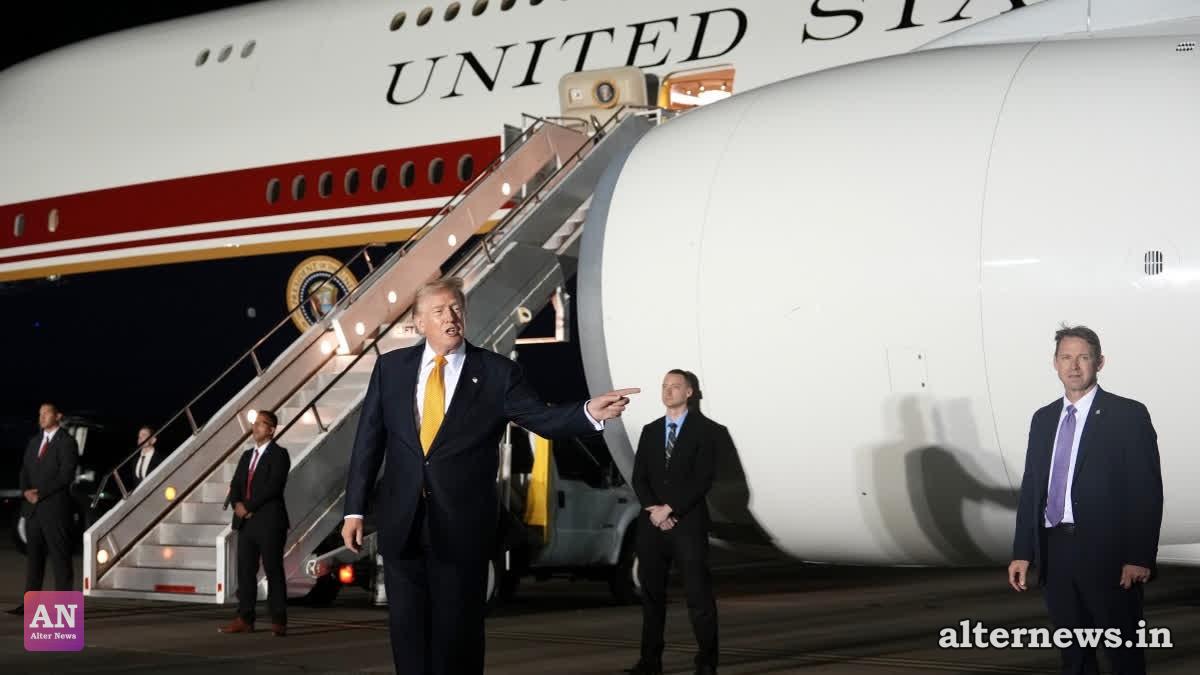
WASHINGTON — President Donald Trump confirmed on Tuesday that the Secret Service and U.S. military officials forced him to secretly switch aircraft following last month’s NATO summit in Turkey, citing a credible threat that security officials reportedly traced back to Iran.
Speaking to reporters upon returning to Washington from an event in Ohio, Trump downplayed both the danger to himself and the elaborate subterfuge required to pull off the covert operation.
"They wanted me to go on a different flight, different plane," Trump said, acknowledging he had little say in the directive. "I guess there was a threat out there. I didn't really ask too much about it. I get a lot of threats."
His comments corroborate a report first published by The Washington Post, revealing that security agencies spirited the president onto a smaller, secondary aircraft while sending Air Force One into the sky to serve essentially as a decoy. The operation remained a closely guarded secret for weeks.
According to details of the covert transfer, Trump hid inside an airport catering container to sneak onto a smaller government plane in Turkey. He was flown to RAF Mildenhall in Suffolk, England, where he surreptitiously reboarded Air Force One undetected before resuming his trip back to Washington.
Despite the security risks that prompted the operation, Trump insisted he felt no fear during the maneuver. "I don't worry about anything, to be honest," Trump remarked. "Whatever it is. You know my attitude? Whatever!"
The president also shrugged off concerns regarding the press pool, support staff, and White House aides left aboard the primary aircraft. Referring back to comments made shortly after the flight, Trump admitted he had brushed off questions about potential danger at the time, even though the press and non-essential staff were unaware they were traveling on a decoy jet.
An Unprecedented Breach of Protocol
While U.S. commanders-in-chief frequently travel under tight security and make unannounced foreign visits to war zones, historians and presidential security experts noted that concealing a president's whereabouts from both the public and his traveling press pool for weeks after the fact is virtually unprecedented.
"We have absolutely seen the president fly on unmarked or decoy planes before, into Iraq, Afghanistan, other war-zone-like places," said Garrett M. Graff, historian and author of Raven Rock. "But this was an ongoing secret that I don't think we've ever seen before."
Graff emphasized that the press pool's presence is vital not only for journalism, but as an essential safeguard for continuity of government during crises. "You can imagine the different ways that this could have gone wrong, where, for a period of time, no one would have been able to independently corroborate the status of the U.S. president, or who was in charge of the U.S. government," Graff noted. "And that's an incredibly dangerous moment for the world."
Historical Precedents of Presidential Misdirection
U.S. presidents have previously employed decoys and misdirection to travel safely into volatile regions, though typically with press knowledge or immediate public disclosure once clear of danger:
Bill Clinton (2000): During a trip from India to Pakistan, Clinton appeared to board a military plane, but walked around the nose of the aircraft to board a second jet parked nearby. White House reporters were informed beforehand that the president would not be on their plane, ensuring transparency.
George W. Bush (2003 & 2001): Bush made a surprise Thanksgiving visit to troops in Baghdad, Iraq, in 2003, with the trip kept secret until Air Force One was safely airborne on its return journey. On 9/11, Bush was moved between Air Force bases under tight security, but White House officials never misled the public about his status.
Donald Trump (2019): In his first term, Trump flew secretly to Bagram Airfield in Afghanistan for Thanksgiving while a decoy plane and press pool remained in Florida to maintain the illusion he was at Mar-a-Lago. However, reporters on board documented the visit as soon as he landed.
Joe Biden (2023): Biden departed the White House at 3:30 a.m. to take a covert 10-hour train ride from Poland into Kyiv, Ukraine, accompanied by a small pool of reporters who documented the high-stakes trip in real time.
White House officials have not yet provided additional details regarding the exact nature of the threat from Iran or why the operation was kept undisclosed for nearly a month.