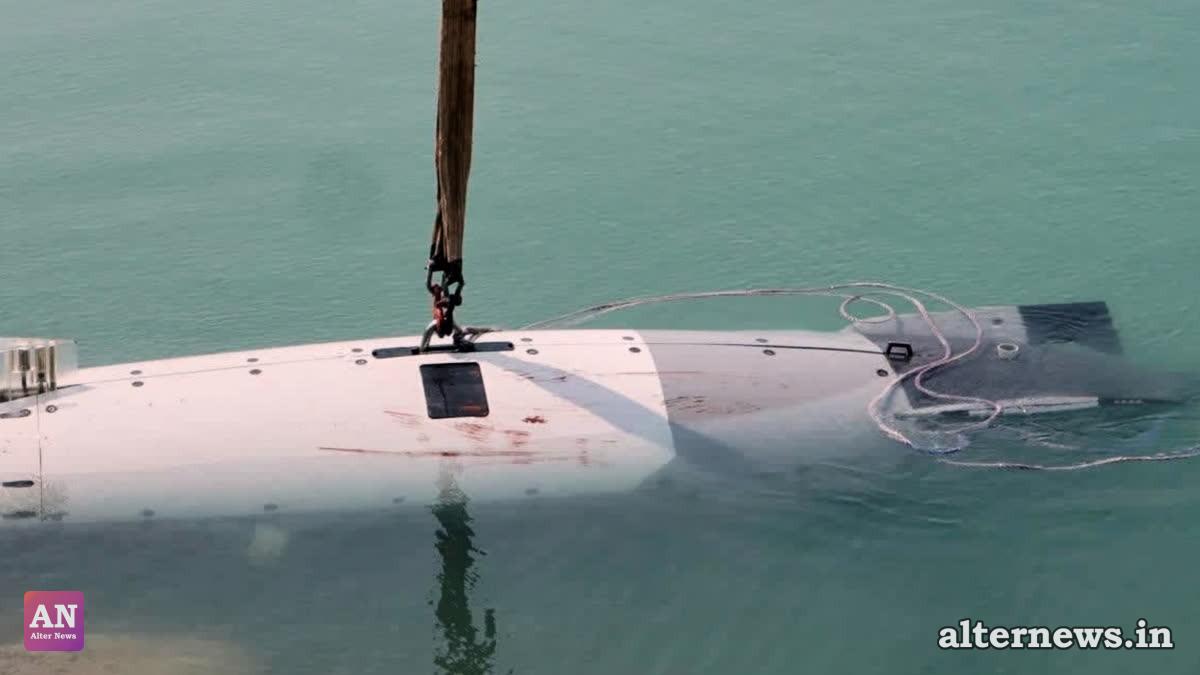
WASHINGTON — The U.S. military downplayed claims by Iran’s Islamic Revolutionary Guard Corps (IRGC) that its forces had carried out a high-level intelligence operation to seize an advanced American unmanned submarine near the strategic Strait of Hormuz.
According to U.S. Central Command (CENTCOM), the device was an older, attritable model that had suffered a mechanical malfunction more than a day before Iranian forces encountered it.
"An underwater drone operated by U.S. forces malfunctioned more than a day ago while surveying regional waters in support of ongoing operations," said CENTCOM spokesperson Navy Capt. Tim Hawkins.
The statement follows Iranian state media reports boasting that the IRGC Navy intercepted "one of the most modern, unmanned, and smart submarines" operated by American forces in a "complex intelligence and operational action" at the entrance to the Strait of Hormuz.
Defense officials confirmed the craft in question was an autonomous extra-large unmanned underwater vehicle (XLUUV)—specifically a Dive-LD model manufactured by defense technology firm Anduril.
Responding to the incident, an Anduril spokesperson emphasized that the system is designed to be "attritable," meaning it is built specifically for high-risk maritime environments where vehicle loss is an anticipated operational possibility.
"Its purpose is to keep warfighters out of the most dangerous parts of the undersea mission," the spokesperson said, adding that the model variant involved had already logged thousands of hours of operational value across months-long deployments under CENTCOM command.
The capture occurs amid heightened military standoff around the Strait of Hormuz—a crucial maritime choke point responsible for carrying roughly one-fifth of global crude oil supply.
While CENTCOM verified that routine U.S. maritime operations in regional waters remain ongoing, the incident highlights persistent volatility in the strategic waterway.