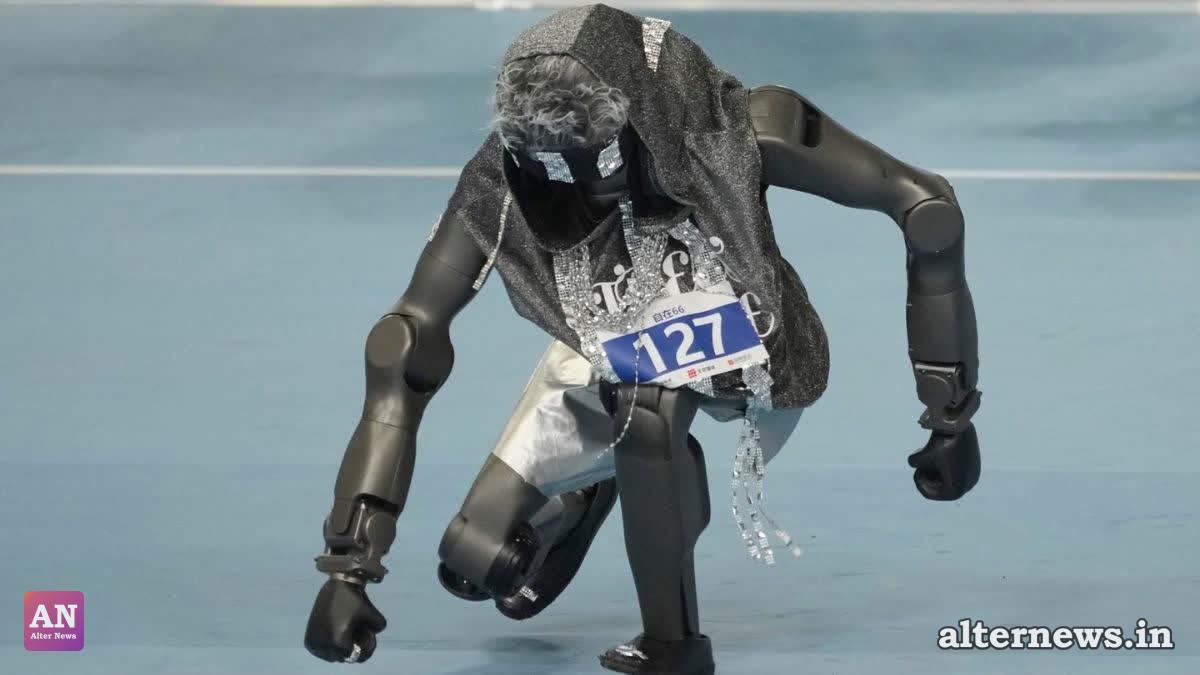
BEIJING — History was rewritten on the track in Beijing on Tuesday, not by flesh and bone, but by gears, actuators, and code. A Chinese humanoid robot stunned spectators at the World Humanoid Robot Games by clocking an astonishing 8.86 seconds in the 100-metre sprint—surpassing both existing mechanical milestones and the fastest human speed ever recorded.
For comparison, legendary Jamaican sprinter Usain Bolt holds the human world record in the 100-metre dash at 9.58 seconds, set in 2009. The previous robotic sprint record of 9.39 seconds had been established just three days prior at the same event.
High-Speed Triumph Ends in Sparks
While the robot's acceleration was a triumph of motion engineering, its dramatic finish highlighted the brutal physical demands of high-speed bipedal locomotion. Upon crossing the finish line at full speed, the machine slammed into a padded barrier, sending bright sparks flying from its waist section before technicians rushed in with extinguishers to douse a minor flare-up.
Robotics experts noted that while breaking speed barriers captures headlines, managing momentum presents an entirely different technical hurdle.
"This is a significant milestone—not simply because the robot ran faster than a human, but because of what it takes to make a bipedal robot run at this speed," said Dennis Hong, a professor of mechanical and aerospace engineering at the University of California, Los Angeles (UCLA). "As speed increases, balance, control, impacts, actuator performance, and mechanical robustness all become much more challenging."
Hong added that the post-finish crash points to critical real-world questions for the next phase of development: whether high-speed autonomous machines can safely decelerate, navigate sudden obstacles, recover from falls, and continue operating reliably in shared human environments.
China's Showcase of Technological Might
Now in its second year, the World Humanoid Robot Games serves as a high-visibility platform for China to showcase its rapid strides in advanced robotics amid an intensifying global technology race with the United States.
The multi-day Olympic-style event drew more than 2,000 robotic entrants from across the industry, competing in over 1,300 individual matches across 51 categories. Outside traditional athletic tracks—which include the long jump, high jump, and table tennis—machines demonstrated agile coordination in ballroom dancing and team-based simulations designed around real-world applications such as emergency response, hotel hospitality, and household chores.
State media outlets emphasized that while consumer-facing "housekeeper" and "caregiver" units remain in pilot testing phases, competitive trials directly accelerate technological maturation. As engineering teams continue refining high-output joint motors and real-time balance control software, trials like Beijing's sprint race mark a major leap toward fully functional, high-performance humanoid robotics.