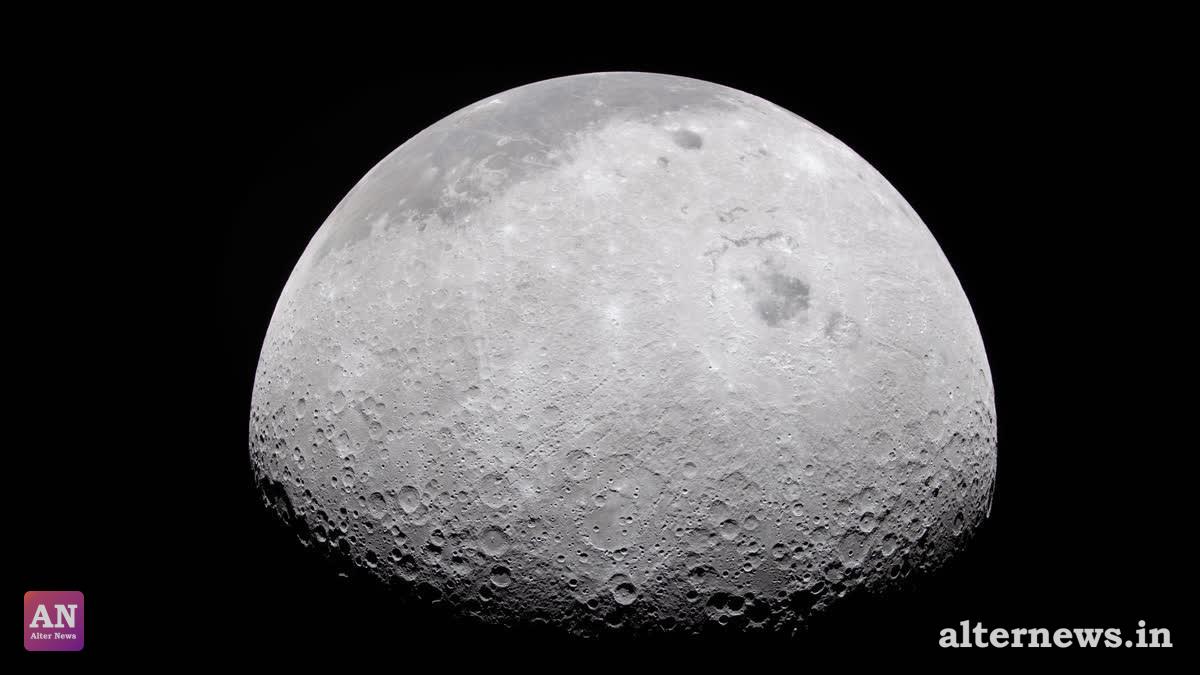
HYDERABAD — NASA has released high-resolution orbital imagery detailing a brand-new crater blasted into the lunar surface when a derelict SpaceX rocket component crashed into the Moon at staggering speeds.
The imagery, captured by NASA’s Lunar Reconnaissance Orbiter (LRO), provides the clearest visual confirmation yet of the impact zone located near the Moon’s sunlit western limb, adjacent to the prominent Einstein Crater.
The collision occurred earlier this month when the upper stage of a discarded Falcon 9 booster slammed into the lunar regolith at approximately 8,700 kilometers per hour (5,400 mph)—nearly seven times the speed of sound. Though the instant of impact was shielded from direct line-of-sight visual observations from Earth, ground-based astronomical monitoring and space agencies quickly pinpointed the trajectory.
Initial reconnaissance was conducted by South Korea’s Danuri spacecraft (operated by the Korea Aerospace Research Institute), which logged the first overhead orbit passes. However, NASA’s LRO—which flies a polar orbit around the Moon every two hours at an altitude of roughly 60 miles (96 kilometers)—subsequently captured higher-contrast, close-range imagery after flight controllers tilted the probe's camera systems directly toward the crash site.
Scientists analyzing the LRO photos estimate the resulting depression measures roughly 60 feet (18 meters) across and less than 10 feet (3 meters) deep.
The images showcase distinct "butterfly wing" ejecta patterns spreading outward from the impact zone. Darker halo regions surrounding the crater consist of rougher surface material altered over millions of years by solar radiation and cosmic rays, while bright streaks extending from the rim represent pristine subsurface soil excavated from beneath the lunar crust during the blast.
The runaway rocket stage originated from a January 2025 launch that successfully deployed Firefly Aerospace’s Blue Ghost 1 lander as part of NASA’s Commercial Lunar Payload Services (CLPS) initiative. While the primary first-stage booster made a controlled return to Earth, the spent upper stage drifted into a high-eccentricity orbit where gravitational perturbations and solar radiation pressure eventually pulled it toward a lunar impact.
Addressing safety concerns regarding space debris, NASA reiterated that such collisions pose no danger to lunar exploration or Earth. The space agency noted that disposing of spent rocket hardware through targeted lunar impacts remains an accepted and standard end-of-life protocol when orbital decay leaves no viable alternative.