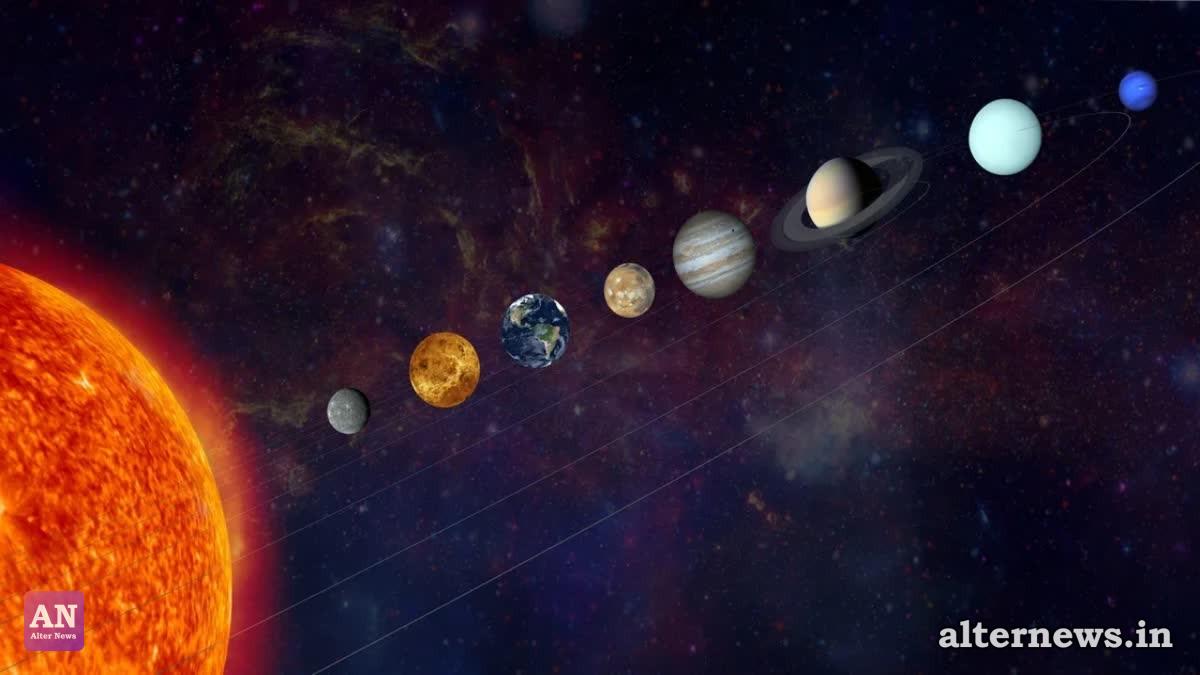
HYDERABAD — Stargazers across the globe are preparing for an extraordinary celestial phenomenon as four major astronomical events—a planetary alignment, a total solar eclipse, a new moon, and the peak of the annual Perseid meteor shower—coincide within the same 24-hour window on August 12, 2026.
While each of these cosmic occurrences happens individually throughout the year, astronomers emphasize that having all four converge on a single calendar day is exceptionally rare.
The Dawn Alignment: A Six-Planet Parade
The day’s astronomical display begins before sunrise, as six planets in our solar system line up across the sky from east to west. Visible in the morning twilight will be Jupiter, Mercury, Mars, Saturn, Uranus, and Neptune.
Observers will be able to spot Mars and Saturn with the naked eye, while the more distant gas giants, Uranus and Neptune, will require binoculars or a backyard telescope to view clearly.
Astronomers note that while the phrase "planetary parade" is widely used by the public and media, it is not an official scientific classification. Andrew Fazekas, communications manager at Astronomers Without Borders, explained that the term simply describes a visual alignment where multiple planets appear in roughly the same region of the sky from Earth's perspective.
Midday Shadow: Total Solar Eclipse Hits Northern Hemisphere
Later in the day, the Moon will pass directly between the Earth and the Sun, casting its umbral shadow across parts of the globe and creating a total solar eclipse.
Path of totality highlights include:
Total Eclipse Locations: Greenland, Iceland, northern regions of Spain and Portugal, and parts of northern Russia.
Partial Eclipse Locations: Extended views across vast areas of Europe, Africa, and eastern North America.
Visibility in India: The eclipse will not be visible from India. By Indian Standard Time (IST), the eclipse occurs between approximately 9:45 PM on August 12 and 2:15 AM on August 13, well after sunset across the subcontinent.
Perfect Pitch Darkness: New Moon Sets Stage for Fireballs
Because a solar eclipse can only happen when the Moon is in its "new moon" phase, the night sky will be left in complete darkness. With no moonlight to illuminate the atmosphere, light pollution from the lunar surface will be virtually zero.
This pitch-black sky creates pristine viewing conditions for the night's main event: the peak of the Perseid meteor shower.
The Night Display: Perseids Peak Under Ideal Conditions
Widely regarded by skywatchers as the most impressive meteor shower of the year, the Perseids are expected to put on an exceptional show. Under these moonless conditions, observers away from city lights could see as many as 100 meteors per hour, including vivid fireballs and long-lasting shooting streaks.
According to BBC Sky at Night, the optimal viewing hours fall in the early morning hours before sunrise on August 12, 13, and 14.
Astronomers highlight that the alignment of the Perseid shower's peak with a new moon will not happen again until 2045—making this August 12 alignment a once-in-a-generation stargazing opportunity.