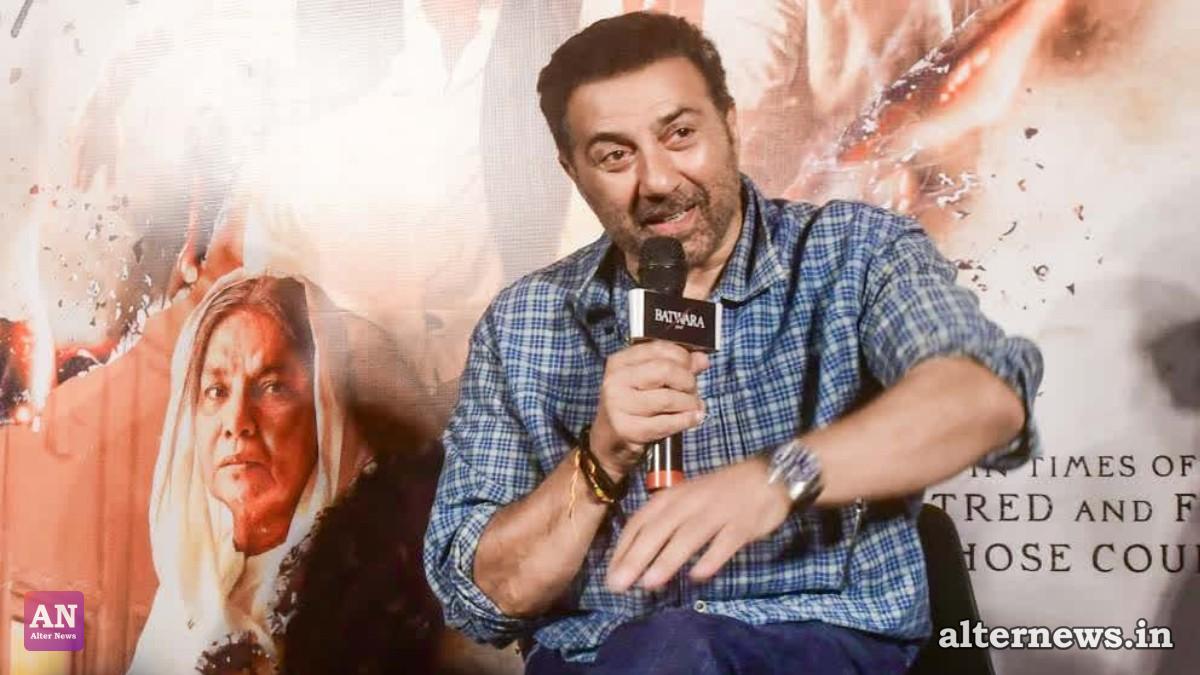
MUMBAI — Legendary action star Sunny Deol is set to return to the big screen on August 14 with Batwara 1947, marking a grand reunion with veteran filmmaker Rajkumar Santoshi nearly 30 years after they delivered timeless Indian cinema classics like Ghayal (1990), Damini (1993), and Ghatak (1996).
Produced by Aamir Khan Productions, the period drama revisits the tragic epoch of Partition. In an exclusive conversation, Deol addressed comparisons with his iconic franchise Gadar, praised Aamir Khan’s production ethos, cleared the air on past rumors of a rift with Santoshi, and firmly maintained that Batwara 1947 makes no attempt to suit the contemporary political climate.
"Batwara 1947 Is a Human Story, Not Gadar"
Given Deol’s celebrated filmography in cross-border and patriotic sagas—from Border (1997) to the record-shattering success of Gadar 2 (2023)—comparisons to Gadar: Ek Prem Katha were inevitable. However, Deol dismissed any narrative similarity between his character Tara Singh and his role in Batwara 1947.
"Tara Singh is a fun-loving, romantic Sardar who loved music and fought for his wife and family," Deol explained with a smile. "In Batwara 1947, my character is already married to Preity Zinta's character and has grown-up children. The family is forced to flee to Lahore following the division of the country. Here, my character fights for someone else—an elderly Hindu woman played by Shabana Azmi—at the cost of his own family’s comfort. This story is fundamentally about the 'batwara' (division) of a family, their experience with oppression, and how they overcome tyranny together."
Reuniting With Rajkumar Santoshi & Aamir Khan’s Role
While Deol and Santoshi defined 1990s action-drama, the duo hadn't collaborated since the late 1990s, giving rise to persistent industry rumors of a fallout over parallel Bhagat Singh projects in 2002. Deol firmly put those rumors to rest, explaining that trade perceptions rather than personal differences kept them apart.
"There was no bad blood. We had been trying to do a film since the early 2000s, including subjects on Asoka and Prithviraj Chauhan. But back then, trade dynamics and producers didn't view us as a saleable combination," Deol shared.
The turning point arrived after the historic box-office resurgence of Gadar 2 in 2023, which opened doors for Aamir Khan to champion the script—a project Deol and Santoshi had discussed as far back as 2010.
Praising Khan's hands-on approach as a producer, Deol noted: "Aamir remembered this subject for years. When another actor who is also a filmmaker produces your project, there is zero insecurity—and that is beautiful. Aamir was deeply invested in ensuring the film was crafted meticulously rather than rushing the production timeline."
Adapting the Literary Classic
Batwara 1947 is adapted from acclaimed playwright Asghar Wajahat’s celebrated play Jis Lahore Nai Vekhya, O Jamya E Nai. Director Santoshi and Wajahat previously acknowledged that the central character, Sikandar Mirza, was rendered more assertive and physically robust on screen to align with Deol's powerful cinematic persona while preserving the play’s core message of humanity and communal tolerance.
When asked about the modification, Deol candidly remarked: "I hadn't watched the original play, but I connected deeply with the story and script narration back in 2010. As an actor, I performed the character as written on the page, and the moment the opportunity presented itself with Aamir backing it, we jumped right in."
The Social Responsibility of Cinema
Reflecting on the profound real-world impact of his cinematic journey, Deol shared how encounters with fans and real-life soldiers altered his perspective over the years. He recalled an incident in England following the release of Border (1997), where a young boy touched his feet at a petrol station, and a recent encounter while filming Border 2 in Dehradun, where a soldier credited the film for inspiring him to wear the Indian Army uniform.
"It makes you realize that while we are making movies, people off-screen are impacted deeply," Deol reflected. "Filmmakers and actors carry a responsibility toward the youth to convey messages of courage, integrity, and being a good human being."
No Political Agenda
Addressing the socio-political context surrounding Partition-themed cinema, Deol emphasized that Batwara 1947 avoids taking political stances or preaching to its audience.
"Cinema reflects society, and this film is an emotional story about ordinary people trapped in one of history’s most difficult periods," Deol stated. "We never approached this film with the intention of taking sides or tailoring it to suit the current political climate. It is simply a story told as it is, and I hope audiences watch it without bias and connect with its core family emotions."