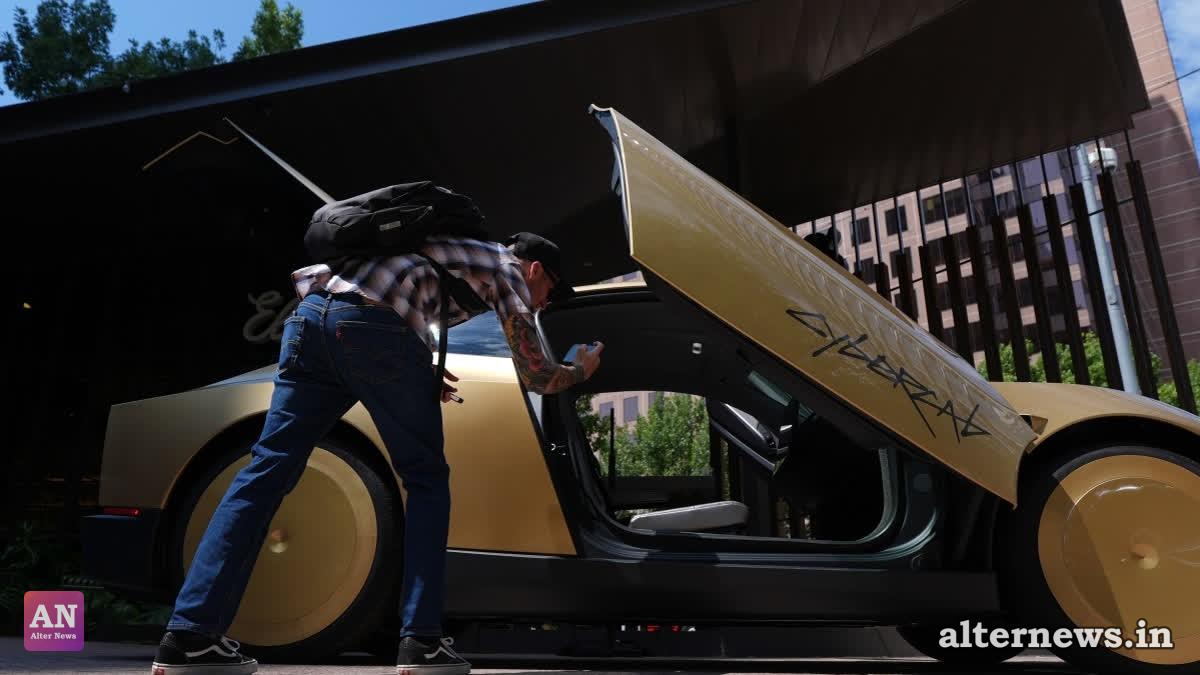
AUSTIN, Texas — Elon Musk made a high-stakes bid to transform public transit on Thursday, dispatching dozens of gold-tinted, steering-wheel-free Tesla Cybercabs onto the streets of Austin, Texas. The bold commercial launch represents Tesla's biggest gamble yet that passengers will overcome their anxiety about riding in autonomous vehicles over which they have zero physical control.
The sleek, pedal-free vehicles offer commuters no traditional manual fail-safes in case of an emergency, relying entirely on Tesla’s vision-only artificial intelligence system. The aggressive expansion comes as Tesla attempts to reinvigorate its brand image and revive investor sentiment following a difficult year plagued by slumping EV sales, intensifying global competition, and heightened regulatory scrutiny.
Traders reacted positively to the Texas rollout, driving Tesla shares up by more than 5% on Thursday as Wall Street speculated whether the futuristic robotaxis could unlock a massive new revenue stream for the EV manufacturer.
Leading up to the deployment, Musk hyped the rollout on his social media platform X, sharing a dramatic digital rendering of a giant Cybercab floating above the Austin skyline accompanied by the caption, "A Storm of Cybercabs."
However, Tesla enters an increasingly crowded and skeptical market. The Austin-based automaker remains locked in a fierce battle with Alphabet's Waymo, the current frontrunner in the driverless taxi market. While Tesla is deploying hundreds of unsupervised vehicles across Texas and Florida, Waymo already operates a fleet of more than 4,000 fully autonomous vehicles spanning 14 major U.S. cities.
Industry experts also highlight a stark divergence in technology strategies. While Waymo and Amazon’s Zoox rely on a multi-sensor array combining cameras, radar, and laser-guided lidar technology, Tesla’s Cybercab relies exclusively on camera hardware and neural network software.
Beyond technology hurdles, public trust remains a formidable obstacle. A Pew Research Center survey conducted earlier this year revealed that 70% of American adults feel uncomfortable riding in a driverless vehicle, with only 7% indicating high confidence in the technology. Separate polling by Gallup showed that safety skepticism surrounding autonomous vehicles has steadily increased over recent years.
Tesla’s corporate performance has also felt the pinch of recent controversies. Sales slumps and mounting competition—most notably from China's BYD, which dethroned Tesla as the world’s top-selling EV maker—led to back-to-back annual sales declines and steep profit drops. Furthermore, regulatory agencies in both the United States and Europe continue to monitor Tesla's full self-driving capabilities closely, investigating several past incidents involving low-visibility driving conditions and traffic violations.
Despite these hurdles, Musk's ultimate vision extends far beyond dedicated taxi fleets. The Tesla CEO envisions eventually releasing full self-driving updates to millions of existing customer-owned Teslas, enabling everyday vehicle owners to enlist their personal cars into an autonomous rideshare network when not in use.
Whether passengers are ready to surrender total control to an AI driver remains to be seen, but with Thursday's Cybercab rollout in Austin, Tesla has officially set its vision of the future into motion.