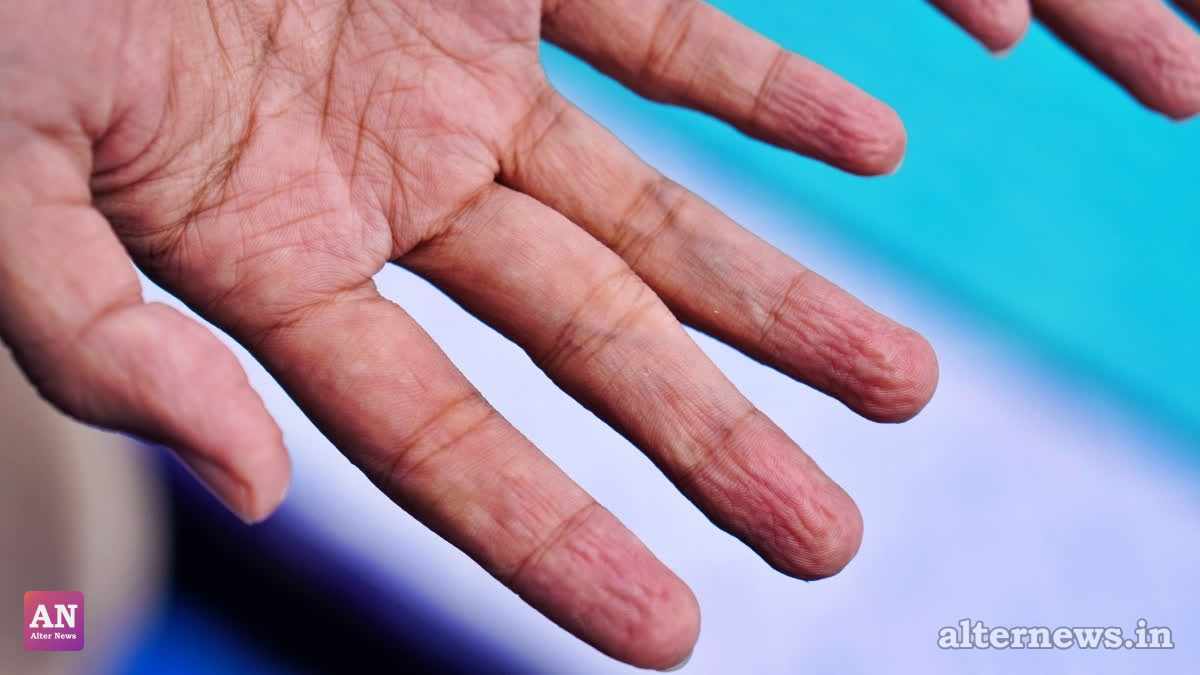
HEALTH DESK — Whether you have spent half an hour soaking in a hot bath, swimming laps, or doing a mountain of dishes, you have almost certainly noticed your fingertips transforming into a shriveled, prune-like state. For generations, the popular explanation was simple physics: our skin was thought to act like a sponge, absorbing water until it swelled into folds.
However, modern research has turned that assumption completely upside down. Scientists now confirm that water-induced finger wrinkling is not a passive process of skin saturation, but rather an active, highly coordinated command executed by your nervous system.
An Active Command from the Nervous System
The secret behind pruney skin lies in the median nerve, a major neural highway running down the arm into the hand. Beyond transmitting sensory signals and controlling fine motor skills, the median nerve governs automatic bodily functions through the autonomic nervous system—the same system regulating heart rate and sweating.
When hands remain submerged in water for roughly 30 minutes, water penetrates the sweat ducts in the fingertips. This triggers a specific neural signal instructing tiny blood vessels beneath the skin to constrict. As these blood vessels narrow, the overall tissue volume inside the fingertip shrinks. Instead of swelling outward, the outer skin layer dips inward, creating distinct grooves and ridges.
If the median nerve is severed or severely damaged, the wrinkling response disappears entirely—proving that the phenomenon is driven by neurological activity rather than osmosis.
Nature’s Rain Tires: Built for Grip
Why would evolution equip human hands with such a specific mechanism? Researchers put this question to the test by evaluating over 500 volunteers instructed to transfer wet and dry objects.
While dry hands had no trouble handling objects, wet, smooth hands naturally struggled with traction. Once participants' fingertips developed water-induced wrinkles, however, the amount of force required to hold onto slippery, submerged items dropped by nearly 50 percent.
The resulting ridges act remarkably like tread patterns on car tires. By creating channels that force surface water away, the wrinkles allow the skin to make direct contact with surfaces, providing crucial traction in wet environments—an evolutionary trait that likely helped early humans gather wet vegetation or grip slippery rocks near streams.
A Diagnostic Tool Hidden in Plain Sight
Beyond its evolutionary purpose, the finger-wrinkling response serves a practical function in modern clinical settings. Because the mechanism depends directly on an intact autonomic nervous system, medical professionals occasionally use a simple hand-soaking test to evaluate nerve health. The absence of wrinkling after prolonged water immersion can alert clinicians to potential nerve impairment or autonomic neuropathy.
Individual Differences and Medical Red Flags
Not everyone develops wrinkles at the same speed or intensity. Studies indicate that water-induced wrinkling becomes less pronounced with age, and women generally take slightly longer than men to develop ridges under water.
While temporary pruney fingers following a bath or swim are entirely harmless and revert within 10 to 20 minutes of drying, persistent or unprovoked wrinkling outside of water can occasionally point to health conditions:
Dehydration: A lack of systemic hydration reduces skin elasticity, leaving skin looking drawn or fine-lined.
Underactive Thyroid (Hypothyroidism): Sluggish thyroid hormone production affects blood circulation and skin texture.
Autoimmune & Circulatory Disorders: Conditions such as Lupus, Scleroderma, or Raynaud’s phenomenon alter localized blood flow to the extremities, affecting tissue volume.
Lymphedema: Fluid retention in tissues can cause thickening and altered skin appearance over time.
For everyday water-induced wrinkling, no treatment or prevention is necessary—it is simply human biology functioning at its finest. If skin dryness or conditions like eczema exacerbate discomfort, doctors recommend maintaining daily hydration, moisturizing regularly, and wearing protective gloves during prolonged household chores.