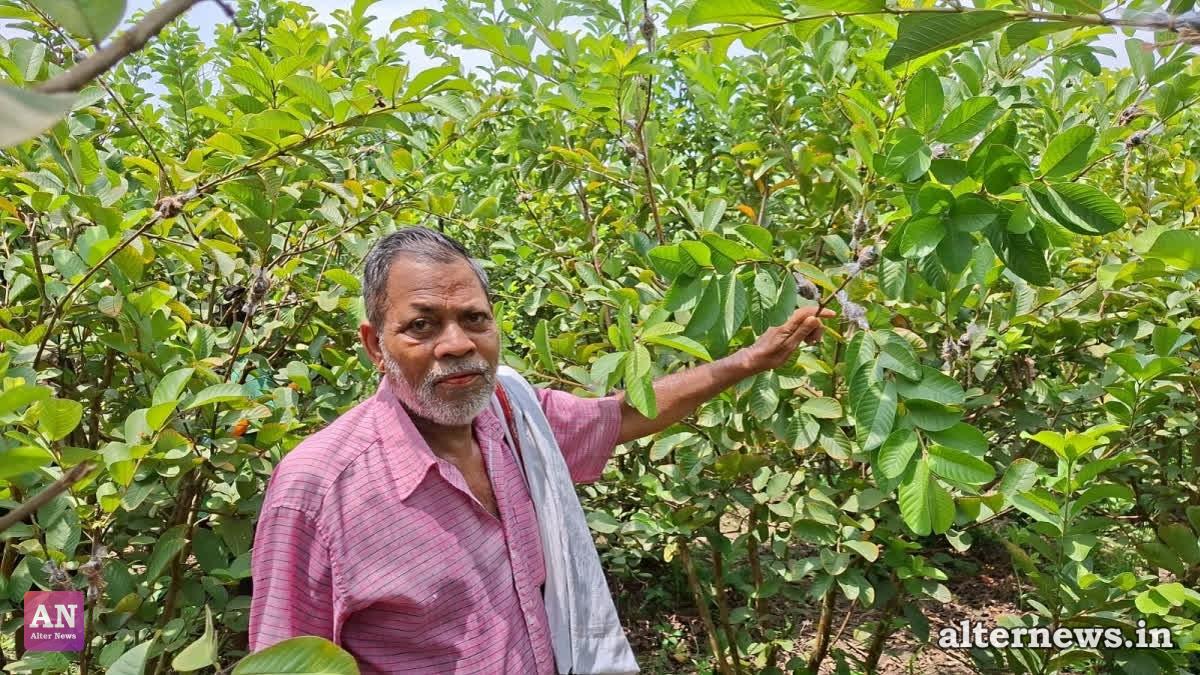
KENDRAPARA, ODISHA — At 72, when most people contemplate a quiet retirement, Padan Nayak is out in his fields by dawn. Walking through his lush orchard in Jaanra Barimul village in Odisha’s Kendrapara district, Nayak inspects branches heavy with pale green and fully ripe guavas, preparing another batch for local markets.
After five decades in agriculture, Nayak’s strategic turn to commercial guava cultivation has turned into an inspiring success story. Today, his farm generates an annual revenue of ₹6 lakh to ₹7 lakh while offering steady employment to local agricultural workers.
A Life Built on Soil and Grit
Nayak’s journey began at age 16 when he started farming on leased plots as a sharecropper alongside his wife, Premalata Nayak. Through decades of relentless manual labor, the couple gradually saved enough to purchase their own land. Over the years, Nayak experimented with a wide spectrum of seasonal crops—ranging from sugarcane, cucumbers, and bitter gourds to pointed gourds, cabbages, and sweet potatoes.
However, the decision that altered his financial trajectory came around 2020. Inspired by agricultural broadcasts on television and instructional videos on YouTube, Nayak noticed the growing commercial potential of guava horticulture.
"I saw how guava cultivation was structured and realized it required significantly less manual labor than traditional seasonal crops—a crucial factor given current farm labor shortages," Nayak shared.
Building the Orchard: From Lowland to High Yield
Nayak took a calculated risk by procuring 500 saplings from Karnataka at ₹300 each, planting them on an initial patch of 10 to 12 gunthas. The land, originally uneven and low-lying, had to be filled and leveled before planting. He also installed four borewells across his farmland to ensure a reliable year-round drip and flood irrigation system.
The returns were almost immediate. Even before the first plantation completed a full year, the farm produced a yield worth ₹1.30 lakh, despite losing nearly five quintals of fruit when heavy branches snapped under the weight of the harvest.
Capitalizing on early gains, Nayak expanded the orchard using vegetative grafting techniques derived from his initial stock, multiplying his tree count without high recurring plant costs.
Steady Profits and Local Employment
Today, Nayak invests approximately ₹2 lakh per year on organic manure, cow dung, drip maintenance, and crop management, realizing net returns between ₹4 lakh and ₹5 lakh annually.
Beyond personal profits, the venture has created steady rural employment. Nayak employs two to three local workers on fixed monthly salaries of ₹12,000 to manage day-to-day operations like irrigation, pruning, and fertilization.
His produce sells at ₹70 to ₹80 per kilogram across major regional markets, including Chandol, Kendrapara, Paradip, Jagatpur, and Tirtol.
Recognition and Message to the Youth
Nayak’s accomplishments have brought him recognition from both private farming organizations and government agencies. Honored as a Krushak Bandhu at a state-level farmers' fair in Bhubaneswar, he has also received official support from the District Horticulture Department.
"Padan Nayak is one of the most versatile and skilled horticulturalists in Kendrapara," said Debadas Dutta, Assistant Director of Horticulture. "He has demonstrated how scientific diversification can transform small landholdings."
Despite threats from seasonal thefts and monkey raids—which require hiring dedicated orchard guards before harvest—Nayak remains steadfast. He hopes his journey encourages younger generations to re-engage with farming.
"Agriculture can provide both financial stability and real fulfillment if approached with modern methods and dedication," Nayak said. "True happiness comes from working the land."