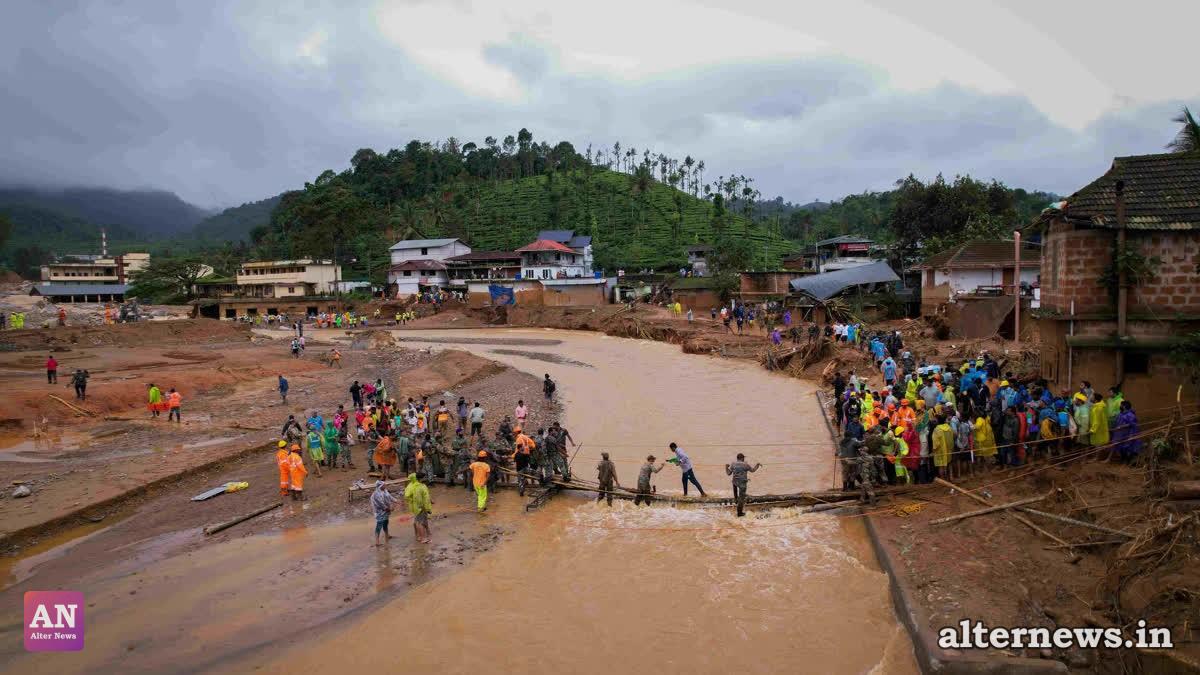
KOZHIKODE — Kerala’s monsoon dynamics are undergoing a drastic transformation, characterized by brief yet exceptionally intense rainfall bursts that severely heighten the risk of devastating landslides across the state’s hilly terrains, according to a leading disaster management authority.
Dr. Maneesha V. Ramesh, Pro Vice-Chancellor at Amrita Vishwa Vidyapeetham and a member of the Kerala Government’s Landslide Advisory Committee, warned that traditional warning protocols based purely on daily rainfall measurements are no longer adequate to safeguard vulnerable communities against modern climate realities.
Speaking on the changing meteorological landscape, Dr. Maneesha emphasized that emergency authorities must look beyond simple 24-hour rainfall figures. Instead, comprehensive risk assessments must integrate antecedent rainfall, multi-day cumulative precipitation, and real-time soil moisture saturation levels.
Rising Frequency of Micro-Cloudbursts
Scientific evaluations indicate that since approximately 2012–13, Kerala has experienced a marked increase in short-duration, extreme precipitation events. The growing occurrence of heavy rainfall days and elevated five-day cumulative totals has rendered slope zones susceptible to cloudburst-like occurrences capable of triggering massive landslides within a matter of hours.
Crucially, experts note that even during El Niño phases—typically associated with overall deficient monsoon activity—localized extreme downpours remain a persistent hazard for fragile hill ecosystems.
Historical data analyzing 5,290 slope failures across the state reveals that prolonged water accumulation over several days, rather than a single day's torrential downpour, serves as the primary catalyst for major landslides. Districts such as Wayanad, Idukki, and Kottayam have emerged as critical hotspots where recurrent heavy rain rapidly saturates hill slopes, raising pore-water pressure and compromising structural soil stability.
The Role of AI and IoT Technology
To counter these escalating hazards, Amrita Vishwa Vidyapeetham deployed India's inaugural AI and IoT-powered Landslide Early Warning System (LEWS) in Munnar in 2009. Utilizing deep-subsurface sensors installed up to 30 meters underground, the technology continuously tracks groundwater movement, soil moisture, pore-water pressure, and crustal shifts.
Artificial intelligence models process these metrics in real time to issue four-tier alert notifications to the Kerala State Disaster Management Authority (KSDMA), granting crucial window time for targeted evacuations. The innovation has earned recognition as a World Centre of Excellence by UNESCO and the International Consortium on Landslides, prompting its expansion to states including Sikkim, Uttarakhand, Karnataka, and Odisha.
In the wake of the devastating 2024 Mundakkai-Chooralmala landslide in Wayanad, spiritual leader and humanitarian Mata Amritanandamayi Devi announced a ₹15-crore commitment to establish advanced warning networks across 20 high-risk sites in the district, including Manikunnu Mala, Chembra Mala, Kalladi, and Vellaramkunnu. Implementation work is currently moving through technical and inter-departmental review stages.
A Multifactorial Challenge
Dr. Maneesha noted that Kerala’s heightened vulnerability stems from a confluence of factors: erratic rainfall patterns, inherently fragile geological formations, steep topographies, and unmanaged human activity—such as dumping excavated earth, which destabilizes slope integrity.
She called for urgent investments in granular hazard mapping, continuous ground monitoring, and modern emergency response infrastructure.
Underscoring India’s growing role in global climate adaptation strategies, Amrita Vishwa Vidyapeetham’s Faridabad campus is set to host the 7th World Landslides Forum from November 23 to 27, bringing together international climate scientists, engineers, and policy leaders to advance next-generation disaster risk reduction frameworks.